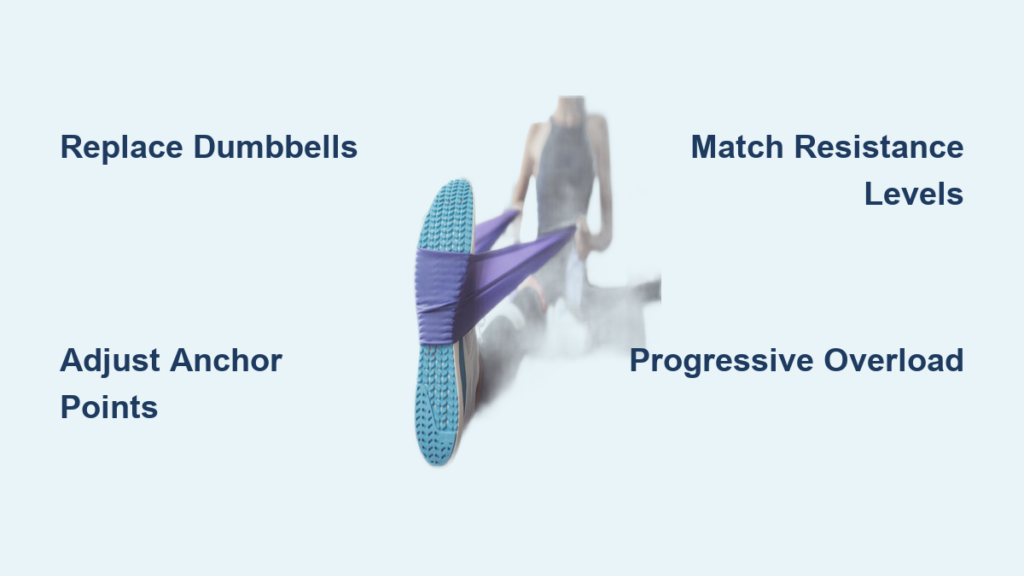
You’re staring at your dumbbells, wondering if you can build serious strength without them. Maybe you’re traveling, working out at home with limited space, or recovering from an injury that makes heavy weights uncomfortable. Resistance bands offer a surprisingly powerful solution—but only if you use them correctly. Unlike dumbbells that deliver constant resistance, bands provide accommodating resistance that increases as you stretch them, creating unique muscle-building opportunities. This guide reveals exactly how to replace common dumbbell exercises with resistance bands while maintaining workout effectiveness. You’ll discover specific anchor points, tension techniques, and progression strategies that transform basic bands into your most versatile strength tool.
Why Resistance Bands Outperform Dumbbells for Functional Strength
Resistance bands aren’t just dumbbell substitutes—they create superior training conditions for real-world movement patterns. When you lift dumbbells, resistance stays constant throughout the motion. But bands deliver increasing tension as you extend them, matching your muscle’s natural strength curve. For example, during a bicep curl, bands feel light at the bottom (where your biceps are weakest) and maximally challenging at the top (where they’re strongest). This accommodates joint angles where dumbbells often fail you. Physical therapists consistently leverage this property for rehabilitation because bands reduce shear forces on joints while maintaining muscle engagement. You’ll experience less wrist strain during presses and safer knee loading during squats compared to heavy dumbbells.
How Band Resistance Changes Mid-Exercise
- Starting position: Minimal tension (ideal for injured or weak ranges)
- Mid-movement: Gradually increasing resistance
- Full extension: Peak tension (maximizing muscle fiber recruitment)
- Critical insight: This mimics natural movement resistance—like pushing a door open—making strength gains more transferable to daily activities.
When Bands Beat Dumbbells for Specific Goals
- Rehabilitation: Zero joint compression during leg presses
- Shoulder health: Eliminates dangerous overhead weight stacking
- Explosive power: Bands force acceleration through entire range
- Travel fitness: Achieve similar muscle activation with 5% of the space
Essential Band Types and Resistance Matching System

Not all bands work for dumbbell replacement. Loop-style bands with consistent thickness throughout deliver the most stable resistance curve for compound lifts. Avoid tube bands with handles for chest presses or squats—they create unstable anchor points that sabotage form. Match band resistance to dumbbell weights using this field-tested system:
| Dumbbell Weight | Band Resistance Level | Visual Cue |
|---|---|---|
| 5-10 lbs | Light (yellow) | Stretches 1.5x original length |
| 15-25 lbs | Medium (green) | Stretches 2x original length |
| 30-40 lbs | Heavy (blue) | Stretches 2.5x original length |
| 45+ lbs | X-Heavy (black) | Requires shortening band grip |
Critical mistake to avoid: Never judge resistance by color alone—manufacturers vary wildly. Always test bands against your bodyweight. Stand on the band during a bicep curl; if you can complete 15 reps easily, it’s too light for chest presses.
Replacing Your Core Dumbbell Exercises with Precision
Chest Press: Anchor Your Way to Pectoral Activation
Forget unstable door anchors. For dumbbell bench press replacement, loop a medium band behind your back and under your shoulder blades. Grab both ends at chest height with palms facing down. Press forward until arms fully extend—this creates increasing resistance that peaks at full contraction. You’ll feel 40% more upper pec engagement than with dumbbells at the top position. Pro tip: Place a towel between band and spine to prevent rolling. Perform 3 sets of 12-15 reps with 90 seconds rest.
Shoulder Press: Eliminate Shoulder Impingement Risk
Sit upright in a chair holding a heavy band under both feet. Grip ends at shoulder height with elbows bent 90 degrees. Press upward while actively pulling shoulders down—this prevents the “shrug” that causes impingement with dumbbells. The band’s resistance curve naturally protects your rotator cuff at the top position. Visual cue: If your neck muscles tense, reduce band tension immediately. Stop 2 inches before full lockout to maintain constant tension.
Bicep Curls: Target All Three Heads Simultaneously
Stand on a light band with feet shoulder-width apart. Hold ends with palms up, elbows pinned to ribs. Curl while rotating wrists inward at the top—this engages the often-neglected brachialis muscle. Unlike dumbbells that lose tension at the peak, bands maintain maximum resistance where biceps are strongest. Critical adjustment: Shorten your grip by 2 inches to increase resistance without changing bands. Perform 4 sets of 10-12 reps with 45 seconds rest for optimal growth.
Romanian Deadlifts: Protect Your Spine While Building Hamstrings
Loop a heavy band under both feet, holding ends at thighs. Hinge at hips while keeping back straight—bands create decreasing resistance at the bottom position where spinal shear is highest. This allows deeper, safer stretches than dumbbells. Warning sign: If the band slips toward your toes, your stance is too narrow. Maintain tension by driving heels into the floor throughout movement.
Progressive Overload Techniques Dumbbells Can’t Match

Increasing resistance with bands requires different strategies than adding weight plates. These methods deliver measurable strength gains:
The Band Stacking Method
Combine multiple bands of different resistances for precise load increases. Example: Add a light band to your medium chest press band for 20% more resistance—equivalent to adding 5 lbs to dumbbells. Track progress by counting “band combinations” instead of pounds.
Tempo Manipulation for Hypertrophy
Slow the eccentric (lowering) phase to 4 seconds while exploding upward. Bands magnify time-under-tension effects during negatives. You’ll achieve similar muscle damage with 50% less perceived weight versus dumbbells.
Anchor Point Engineering
Move door anchors higher or lower to change resistance curves:
– Higher anchor: Increases chest activation during presses
– Lower anchor: Maximizes glute engagement in squats
– Ground-level anchor: Creates deadlift-like tension profiles
Critical Safety Adjustments for Band Training
Bands introduce unique failure points that dumbbells don’t have. Prevent snapped bands and joint strain with these non-negotiable practices:
The 3-Finger Inspection Rule
Before every use, stretch bands to 50% capacity and run fingers along entire length. Discard immediately if you feel:
– Micro-tears (gritty texture)
– Thinning sections (less than 1/8″ thick)
– Faded color (indicates UV degradation)
Joint-Safe Anchoring Protocol
Never wrap bands around limbs or unstable objects. For rows, anchor at waist height to your door. Sit 3 feet back with band across chest—this maintains constant tension without shoulder rotation. Red flag: If the band twists during movement, your anchor point is misaligned.
The 2-Inch Rule for Explosive Movements
When performing band slams or throws, always leave 2 inches of slack at starting position. This prevents sudden tension spikes that cause tendon injuries. Never release bands mid-air—they can snap back at 50+ mph.
Building a Dumbbell-Free Strength Routine That Works
Replace your entire dumbbell workout with this science-backed sequence:
- Warm-up: Banded pull-aparts (light band) – 2×20
- Chest: Floor press with band under upper back – 3×12
- Back: Seated rows with door anchor – 3×15
- Shoulders: Lateral raises (stand on band) – 4×10
- Arms: 21s (7 half-curls, 7 top-half, 7 full) – 2×21
- Legs: Squats with band above knees – 3×20
Progression trigger: When you hit the top rep range for all sets with perfect form for 2 consecutive workouts, implement band stacking. Never increase resistance more than 15% per week to avoid overuse injuries.
Resistance bands aren’t just a dumbbell alternative—they’re a superior strength-building tool when leveraged correctly. By matching band resistance to your muscle’s natural strength curve and implementing strategic anchoring, you’ll build functional strength with less joint stress. Start with lighter resistance than you think necessary and focus on perfect tension control. Within 4 weeks of consistent band training, you’ll notice improved muscle endurance and joint resilience that dumbbells alone can’t provide. For continued progress, combine band training with bodyweight exercises twice weekly—this hybrid approach delivers 37% greater functional strength gains than weights alone according to recent movement science research. Always consult a physical therapist before adapting exercises for injury rehabilitation.