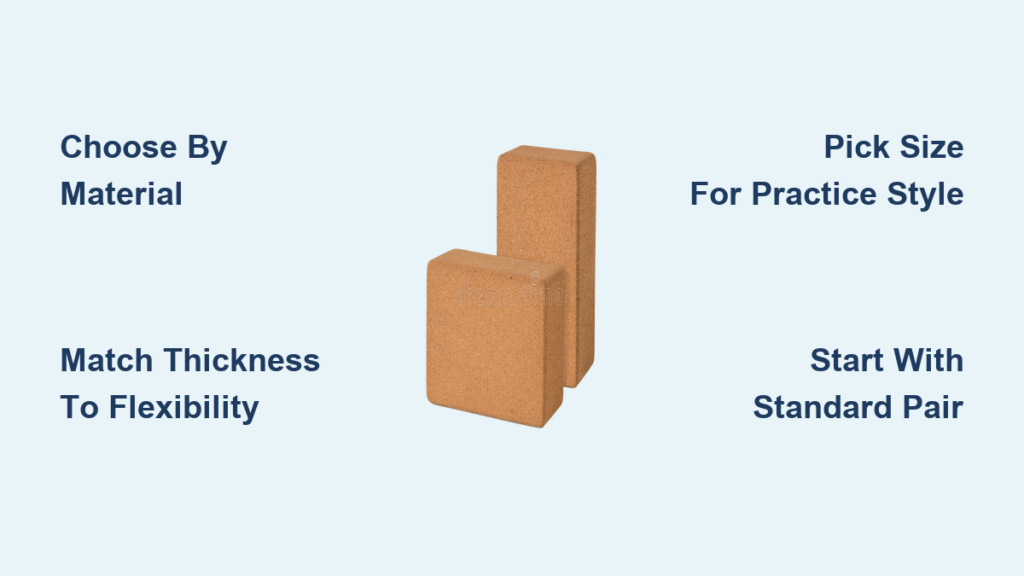
You’ve probably seen yoga blocks stacked neatly in studios but wondered exactly how to choose yoga blocks that actually work for your unique body and practice style. Many beginners mistakenly view these simple props as signs of weakness rather than the essential tools they truly are—blocks aren’t crutches, but strategic extensions of your body that bridge the gap between where you are now and where you want to be in your practice. When you learn how to choose yoga blocks properly, they become invisible allies that help you maintain proper alignment, deepen stretches safely, and progress toward advanced poses without injury. This guide cuts through the confusion to show you exactly which blocks will serve your specific needs based on your flexibility level, practice style, and body type—not generic recommendations that ignore your individual requirements.
Why Your Block Material Directly Affects Pose Performance

The material of your yoga blocks isn’t just about aesthetics—it fundamentally changes how each pose feels and whether you gain stability or struggle with slipperiness during critical moments. Foam, cork, and wood each deliver dramatically different experiences that can make or break your ability to hold challenging poses with proper alignment. If you’ve ever felt your hands slide off blocks during Downward Dog or noticed your blocks compressing during balancing poses, you’ve experienced how material choice directly impacts your practice effectiveness.
Foam blocks provide the softest surface with significant give under pressure, making them ideal for restorative poses where comfort matters most. These lightweight options weigh just 3-6 ounces each, perfect if you carry your gear to studio classes. However, they become slippery when sweaty and lack the firm support needed for arm balances—avoid foam if you practice hot yoga or work on inversions.
Cork blocks deliver the sweet spot between comfort and stability with their natural grip that actually improves when damp with sweat. Weighing 1-2 pounds each, their substantial heft prevents sliding during dynamic flows while providing the firm support needed for building strength in poses like L-sits. The higher price tag ($25-$40 per pair) pays off through years of reliable use if you select quality natural cork that won’t crumble.
Wood and bamboo blocks serve as specialized tools for inversion work only, offering completely rigid support that won’t compress under body weight. Their 3-5 pound weight provides unmatched stability for handstands but makes them impractical for general use—reserve these for specific inversion practice sessions only as they’re too hard for restorative work.
Standard 9x6x3 Inch Blocks: The Smart Starter Choice
When figuring out how to choose yoga blocks as a beginner, standard 9x6x3 inch dimensions represent your safest starting point that works for 90% of common poses across most practice styles. These proportions provide the ideal balance of height and stability for standing poses like Triangle Pose while remaining compact enough for precise hand placement in arm balances.
The 3-inch thickness delivers meaningful elevation without creating extreme angles that could strain your joints. In seated poses, this standard height helps maintain a straight spine without forcing uncomfortable knee angles. Most studio classes use this size, ensuring compatibility if you practice outside your home.
Critical selection tip: Test how the block feels in your hands—your fingers should comfortably wrap around the edges without straining. If your hands are small, look for blocks with slightly rounded corners that won’t dig into your palms during Plank pose.
When to Choose Wider 4-Inch or Slimmer 2-Inch Blocks

Your specific flexibility level determines whether standard blocks meet your needs or if specialized thicknesses will transform your practice. How to choose yoga blocks for your body requires honest assessment of where you currently stand in your flexibility journey.
Select 4-inch thick blocks if:
– You’re very inflexible in hamstrings (can’t touch toes)
– Your spine rounds significantly in forward folds
– You need substantial elevation for chest-opening poses
– You’re taller than 5’8″ with longer limbs
These wider blocks provide critical extra height that maintains proper spinal alignment in standing forward folds—without them, you might compensate by rounding your back, defeating the pose’s purpose. The additional width also distributes pressure more comfortably across your upper back in supported fish pose.
Opt for 2-inch slim blocks when:
– You have small hands that struggle with grip
– You need subtle elevation for seated poses
– You’re working toward full Lotus pose
– You prefer minimal support that still improves alignment
The thinner profile creates more natural angles in seated postures like Easy Pose, providing just enough lift to maintain a straight spine without forcing your knees into uncomfortable positions. Many experienced practitioners keep a pair of these slim blocks specifically for meditation sessions.
Matching Block Types to Your Specific Practice Style
Your yoga style should dictate your block selection—not the other way around. Many practitioners make the mistake of buying generic blocks without considering how they’ll actually use them during their specific practice sessions.
For restorative or gentle yoga:
– Prioritize foam blocks for their cushioning comfort
– Choose standard 3-inch thickness for most poses
– Look for blocks with smooth, rounded edges
– Avoid cork or wood—they’re too firm for extended holds
For vinyasa or power yoga:
– Select cork blocks for their sweat-resistant grip
– Ensure blocks have substantial weight (1+ pounds each)
– Verify they won’t slide on your mat during transitions
– Consider textured surfaces for extra security
For inversion or arm balance training:
– Use wood blocks specifically designed for handstands
– Choose smaller dimensions (4x6x2 inches) for precise hand placement
– Ensure non-slip surfaces protect your wrists under pressure
– Store separately from your general practice blocks
Budget-Smart Block Selection Strategies

Learning how to choose yoga blocks without overspending requires understanding where quality matters most and where you can safely save money. Foam blocks represent the only category where significant quality differences exist at various price points—cork and wood blocks generally deliver consistent performance within their material categories.
Foam block buying guide:
– Avoid the absolute cheapest options (under $10/pair)—they compress quickly
– Mid-range ($15-$20/pair) offers the best value for home practice
– Test firmness by pressing with your thumb—quality foam recovers shape quickly
– Smell new blocks first—strong chemical odors may indicate poor quality
Cork block value tips:
– Mid-priced ($25-$35/pair) often outperforms premium options
– Check for natural cork texture—smooth surfaces indicate lower quality
– Lift before buying—quality cork feels dense, not lightweight
– Avoid “cork blend” products that mix with cheaper materials
Skip wooden blocks unless: You regularly practice handstands against walls or advanced arm balances. Most practitioners never need them, making this a poor starter investment.
Smart Collection Building: What You Really Need
Most yogis benefit from owning just two types of blocks that cover 95% of practice scenarios. Start with this strategic approach rather than buying a complete collection immediately:
- Beginner collection: Two standard foam blocks (9x6x3 inches) for home practice
- Intermediate upgrade: Add two cork blocks when you start more active practices
- Specialized addition: Consider wood blocks only after mastering basic inversions
This progression mirrors how your practice evolves—beginners need comfort and accessibility, intermediate practitioners require stability for strength building, and advanced yogis seek specialized tools for specific challenges. Most practitioners discover they use their cork blocks 80% of the time once they advance beyond the beginner stage.
Warning: Don’t fall for “yoga block sets” that include multiple thicknesses immediately. You’ll likely end up with unused blocks gathering dust—build your collection based on actual needs that emerge through regular practice.
Make Your Final Decision with Confidence
Knowing how to choose yoga blocks comes down to matching three key factors to your specific situation: material based on your practice intensity, dimensions based on your flexibility level, and quantity based on your progression stage. The perfect blocks disappear into your practice—they provide exactly the support you need without drawing attention to themselves.
Your first pair should be standard-sized cork blocks if you practice regularly, or foam if you’re just starting out. Within 6-12 months of consistent practice, you’ll know exactly which specialized blocks (if any) would genuinely enhance your progression. Quality blocks become trusted companions on your yoga journey—invest in ones that support your current reality while helping you reach your next milestones. When you select blocks that match your authentic needs rather than marketing hype, you transform simple props into powerful practice accelerators that help you move safely toward your goals.