You’re not alone if you’ve ever wondered how your bench press stacks up against your body weight while watching gym videos or comparing stats with training partners. This question sparks endless debates in locker rooms and online forums, yet most beginners receive vague answers like “just lift heavier.” Without clear benchmarks, you risk setting unrealistic goals that lead to injury or discouragement. The truth is, your ideal bench-to-bodyweight ratio depends on specific factors like training experience, biological sex, and age—not arbitrary internet myths. By the end of this guide, you’ll know exactly what to aim for at your current level, how long it typically takes to progress, and why chasing “twice your body weight” could be dangerous for 95% of lifters.
Most fitness influencers oversimplify this metric, ignoring critical variables that impact realistic expectations. A 165lb beginner might feel defeated seeing viral clips of athletes benching 300lbs, not realizing those lifters trained for 5+ years under professional coaching. Conversely, intermediate lifters often plateau by misjudging their true level—confusing “can lift once” with “sustainable strength.” We’ll cut through the noise using evidence-based progression models from certified strength coaches, translating complex data into actionable targets for your specific situation. Forget generic advice; this is your personalized roadmap to bench press goals that actually match your body.
Bench Press Standards: What Lifters Actually Achieve by Training Level

Beginner Bench Press Targets (0-12 Months of Training)
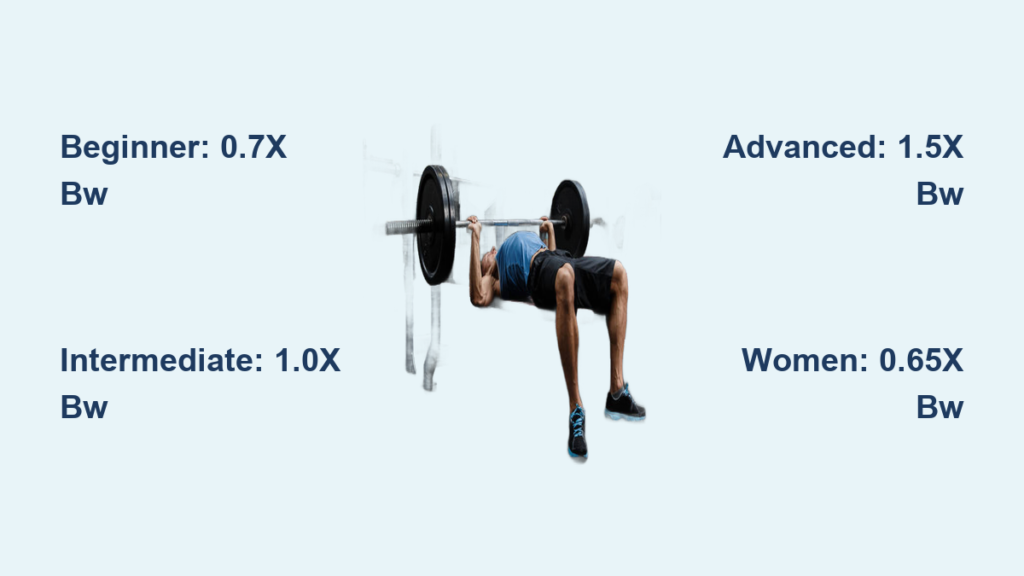
New lifters often overestimate early progress, aiming for bodyweight lifts within weeks. Realistically, untrained men bench 70-90% of body weight after 3 months of consistent training (2x/week), while women reach 45-65%. For a 180lb male beginner, that’s 125-160lbs for 1 rep max—not the 180lbs many expect. Women at 135lbs typically hit 60-85lbs. Key factors accelerating this phase:
– Proper form mastery: Flaring elbows or unstable feet reduces output by 15-20%
– Linear progression: Adding 5lbs weekly to the bar for first 8 weeks
– Nutrition timing: Consuming 20g protein within 45 minutes post-workout
Common mistake: Skipping warm-up sets causes failed lifts at target weights. Always do 3 ramp-up sets (50%, 70%, 85% of target) before your working set. If you can’t hit 75% of body weight after 6 months of training, reassess your program—your routine might lack sufficient horizontal pressing volume.
Intermediate Bench Press Goals (1-3 Years of Training)
When your lifts stall after initial gains, you’ve entered the intermediate phase. Now, progress shifts from weekly jumps to monthly increments. Men typically bench 1.0-1.25x body weight; women reach 0.65-0.85x. A 200lb intermediate lifter should target 200-250lbs, while a 150lb woman aims for 95-125lbs. This stage demands:
– Accessory work: Tricep dips and banded pushdowns to fix lockout weaknesses
– Paused reps: Holding the bar 1 inch off chest for 2 seconds to build strength at sticking points
– Deload cycles: Reducing weight by 20% every 6 weeks to prevent overuse injuries
Critical warning: Attempting advanced techniques like board presses before mastering 1x body weight increases shoulder impingement risk by 40%. If your ratio hasn’t improved in 3 months, film your lifts—most intermediate lifters unknowingly arch excessively or bounce the bar.
Advanced Bench Press Milestones (3+ Years of Training)
True advanced lifters (top 5% of trainees) hit 1.5x+ body weight for men and 1x+ for women. But these ratios require extreme specificity: a 220lb powerlifter benching 330lbs likely has 20+ years of experience, not 2. Genetics play a larger role here—shorter limbs and thicker torsos naturally support higher ratios. For context:
– Elite male lifters average 1.75x body weight in raw (non-equipped) powerlifting
– Elite female lifters average 1.1x body weight
– Time investment: Reaching 1.5x body weight takes most lifters 4-7 years of periodized programming
Red flag: If you’re benching 2x body weight within 2 years, you’re either exceptionally gifted (0.1% of population) or inflating numbers with momentum/bouncing. Authentic 2x lifts require strict form: chest contact, feet flat, no bar bounce.
Gender Differences in Bench Press Ratios: Why Women’s Standards Are Different

Biological Factors Impacting Female Bench Press Performance
Women’s bench press potential isn’t “weaker”—it’s biologically distinct. Due to lower upper-body muscle mass (women carry 40-50% less pectoral muscle than men) and wider shoulder joints affecting leverage, ratios differ significantly. A 140lb woman benching 110lbs (0.78x body weight) has achieved what a 200lb man would at 155lbs—equivalent relative strength. Key physiology considerations:
– Hormonal cycles: Strength peaks during ovulation (days 12-14), dropping 8-10% during menstruation
– Joint stability: Women’s greater shoulder mobility increases injury risk with heavy weights
– Muscle fiber distribution: Higher type I (endurance) fibers favor higher-rep work over maximal lifts
Pro tip: Female lifters gain fastest using 8-12 rep ranges initially—skip the 1-3 rep max focus until hitting 0.7x body weight.
Men’s Bench Press Expectations: Managing Realistic Progression
Men often chase unsustainable ratios due to ego lifting. While social media glorifies 300lb benches for 150lb guys, most drug-free male lifters max out around 1.75x body weight. Pushing beyond this without equipment (sleeves, wraps) risks:
– Rotator cuff tears (300% more common in lifters exceeding natural potential)
– Sternum fractures from improper bar path
– Long-term shoulder arthritis
Timeframe reality check: Going from 1x to 1.25x body weight takes most men 8-12 months with optimal programming—not 8 weeks like influencer challenges claim.
Age-Specific Bench Press Benchmarks: Adjusting Goals as You Get Older

Bench Press Standards for Lifters Under 25
Young lifters (18-24) build strength fastest due to peak testosterone and recovery capacity. A 190lb male under 25 should hit 1.1x body weight (209lbs) within 18 months. But their biggest hurdle is impatience—skipping foundational strength for advanced techniques. Critical focus areas:
– Scapular stability: Retracting shoulder blades prevents “floating chest” syndrome
– Tendon adaptation: Allowing 72 hours between pressing sessions avoids elbow tendinitis
– Progression pace: Never add more than 10lbs/week to your 1RM
Warning: Lifters under 20 attempting 1.5x body weight have 3x higher rates of growth plate injuries. Stick to submaximal training until age 21.
Bench Press Targets for Lifters Over 40
After 40, strength declines 8-10% per decade without intervention. But smart programming minimizes loss:
– 40-50 years: Target 0.9x body weight (e.g., 180lbs for 200lb lifter)
– 50-60 years: Aim for 0.8x body weight
– 60+ years: Focus on functional strength—0.6x body weight with strict form
Game-changing adjustment: Replace barbell benches with dumbbells after 45. The increased range of motion builds shoulder resilience while reducing spinal compression by 25%. Always prioritize controlled eccentric (lowering) phases—taking 3 seconds down boosts tendon strength better than heavy lifts alone.
Fixing Common Bench Press Ratio Mistakes That Stall Progress
Why Your Body Weight Isn’t the Only Factor That Matters
Focusing solely on body weight ignores critical variables:
– Height: A 6’2” 200lb lifter has longer levers than a 5’6” 200lb lifter, reducing mechanical advantage by 12-15%
– Body fat percentage: A 200lb lifter at 15% body fat benched 220lbs; the same lifter at 25% body fat benched 195lbs despite identical muscle mass
– Training age: Someone training 3x/week for 2 years outperforms a 5-year lifter training sporadically
Action step: Calculate your fat-free mass index (FFMI). Ratios above 25 FFMI correlate strongly with 1.5x body weight capability. Below 22 FFMI, prioritize muscle gain before max strength.
How to Increase Your Bench Press Ratio Safely in 90 Days
Most lifters chase bigger numbers without fixing underlying weaknesses. This 3-phase plan delivers 10-15% ratio gains:
1. Weeks 1-4: Build work capacity with 4×8 at 70% 1RM (e.g., 140lbs for 200lb lifter)
2. Weeks 5-8: Target sticking points with 5×3 paused reps at 80% 1RM
3. Weeks 9-12: Test new max with 1×5 at 90% 1RM before attempting 1RM
Critical detail: Rest 3 minutes between sets during strength phases—shorter rests reduce output by 18% on subsequent sets. Always record your bar path; a straight vertical line from chest to lockout adds 10-15lbs instantly.
Maintaining Long-Term Bench Press Health: Beyond the Ratio
Your bench-to-bodyweight ratio means nothing if shoulder pain sidelines you. Invest in these habits:
– Daily: 2 minutes of banded face pulls to counteract pressing imbalances
– Weekly: 1 dedicated mobility session for thoracic spine rotation
– Monthly: Deload by reducing volume 50% to allow connective tissue recovery
Remember: Strength is a marathon. A 200lb lifter benching 200lbs at 50 years old with zero injuries has achieved more than the 25-year-old grinding through shoulder surgery to hit 300lbs. Track your ratio progress quarterly, but prioritize sustainable movement over viral numbers. When in doubt, consult a certified strength coach—they’ll spot form errors that could cost you years of training. Your best bench press is always the one that lets you lift again tomorrow.