That unsettling moment when your hand slides during downward dog or your foot skids in warrior II—nothing ruins your yoga flow faster than a slippery mat. Whether you’re a beginner or seasoned practitioner, losing traction mid-pose breaks your concentration, compromises alignment, and can even lead to injury. The good news is that mat slipping isn’t something you have to accept—it’s a fixable problem with the right approach. This comprehensive guide delivers actionable solutions to keep you grounded through every pose, from selecting the perfect mat material to mastering grip techniques that work even when you’re sweating heavily. Discover how to transform your practice from a constant battle with slipping into a seamless, connected experience.
Why Your Yoga Mat Becomes a Slippery Surface
Understanding what causes mat slipping helps you target solutions effectively rather than guessing at random fixes. Three interconnected factors primarily determine your mat’s grip performance during practice.
Your mat’s material composition creates the foundation for grip potential. Budget PVC mats often feel sticky initially due to factory coatings that wash away after several uses, leaving a frustratingly smooth surface. The texture matters immensely—mats with open-cell surfaces allow slight “sink-in” for better contact, while closed-cell surfaces resist moisture penetration but may offer less natural grip. Smooth, non-porous materials simply can’t generate the friction needed when moisture enters the equation.
Sweat transforms even decent mats into slippery hazards within minutes of moderate practice. That thin layer of moisture between your skin and mat acts as a lubricant, reducing friction dramatically. Hot yoga practitioners face this challenge most acutely, but even gentle styles generate enough perspiration to compromise grip over time. The problem worsens when you move from cooling poses to heating sequences—your mat might feel fine during savasana but become treacherous during sun salutations.
Mat age and condition directly impact grip consistency across your practice surface. New mats often have that temporary factory coating, while older mats develop worn spots where repeated hand and foot placement has smoothed the texture. Improper cleaning compounds the problem—accumulated oils, lotions, and dead skin cells create a slippery film that degrades traction even on high-quality materials. Many practitioners don’t realize their cleaning routine might be making slipping worse rather than better.
Select Your Mat Based on Grip Performance

Choosing the right mat upfront prevents countless frustrations during practice. Different materials deliver dramatically different grip characteristics that match specific practice styles and body types.
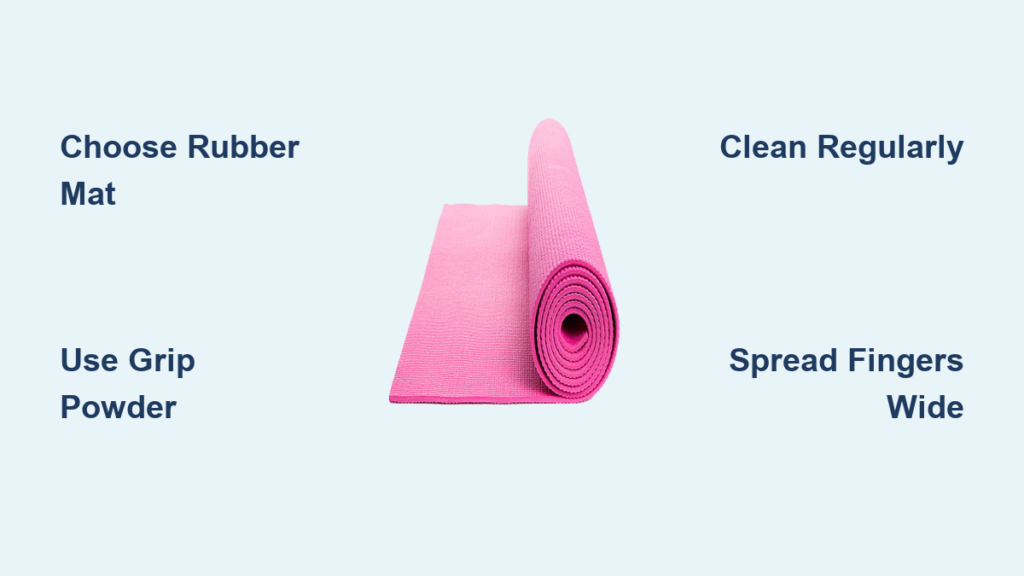
Natural rubber mats provide exceptional grip that actually improves with moisture. The porous surface creates excellent traction without requiring a break-in period, making rubber ideal for hot yoga practitioners and heavy sweaters. Just be aware that natural rubber has a distinct smell initially and may cause reactions in latex-sensitive individuals. These mats typically weigh more than synthetic options but deliver superior grip that lasts throughout their lifespan.
Cork mats offer a unique solution that becomes stickier when wet. The natural properties of cork activate with moisture, providing better grip during heated practices. Cork’s antimicrobial qualities also resist odor buildup better than many alternatives. While cork mats tend to be heavier and more expensive, practitioners who sweat heavily often find the investment worthwhile for consistent traction.
High-density PVC mats deliver reliable performance for moderate practices when selected carefully. Look for textured surfaces and “non-slip” labeling rather than the thinnest budget options. Higher-quality PVC maintains better grip through multiple uses, though it tends to become slippery when wet. These mats represent a good middle ground for practitioners who don’t sweat excessively and practice primarily in climate-controlled environments.
Clean Your Mat to Restore Maximum Grip
Regular cleaning isn’t just about hygiene—it directly impacts your mat’s ability to maintain traction throughout practice. Dirty mats develop a slippery film that undermines even the best grip materials.
Establish a cleaning schedule based on your practice frequency. Heavy sweaters practicing daily should clean after every session, while casual practitioners might manage with weekly cleaning. At minimum, wipe down high-contact areas with a damp cloth after practice to remove immediate residue. Neglecting cleaning allows oils and dead skin cells to accumulate, creating that slick surface that causes slipping.
Use appropriate cleaning solutions that preserve mat texture. A 1:1 water and white vinegar solution works effectively for most mats, removing residue without damaging surface texture. Avoid harsh chemicals, bleach, or ammonia-based cleaners that degrade mat surfaces over time. For rubber mats, test any solution on a small corner first to check for discoloration.
Ensure complete drying before storage to prevent mold and maintain grip consistency. Air dry in a well-ventilated area away from direct sunlight, which can fade colors and degrade materials. Never roll up a damp mat—this traps moisture that breaks down materials and creates slippery patches over time. If you’re short on time, wipe with a dry towel first, then finish air drying completely.
Optimize Hand and Foot Placement for Maximum Traction

How you position your contact points on the mat significantly impacts your ability to maintain grip throughout practice.
Spread fingers and toes wide to maximize contact surface area. This simple adjustment creates more friction points and distributes weight evenly across your entire hand or foot. Many practitioners unconsciously curl fingers or scrunch toes during challenging poses, dramatically reducing available grip. Consciously spreading wide upon each placement develops a habit that prevents slipping.
Engage hand and foot muscles without clenching to maintain connection through transitions. Imagine your hand as a suction cup that gently presses and holds rather than a flat surface that merely rests. This subtle muscular engagement creates a slightly arched structure that maintains contact even as you shift weight. In plank position, press through your entire palm rather than concentrating weight into just the heel of your hand.
Adjust angles based on pose requirements to find optimal stability. Some poses benefit from slightly curved fingers that create a more natural grip shape, while others require straight fingers. Your feet similarly respond to different positioning—sometimes a slight turnout provides better stability while other poses require parallel alignment. Pay attention to which placements feel most stable for your body.
Implement Immediate Slip Fixes During Practice
:max_bytes(150000):strip_icc()/shp-yoga-towels-test-jade-lightweight-great-grip-jkim-0548-59cf4683c8f64eb4990714bd59064f4f.jpeg)
When slipping occurs mid-session, these quick interventions restore grip without disrupting your flow.
Apply a light dusting of grip-enhancing powder to problematic areas. Specialized yoga grip powder creates immediate friction improvement—just a small amount goes a long way. Test any product on a small area first to ensure compatibility with your mat material. Avoid over-application, which can create mess and reduce grip elsewhere.
Reposition on fresher mat surface during longer practices. Your mat’s grip varies across its surface as different areas accumulate moisture and wear. Shifting your position periodically redistributes contact to areas with better texture. During extended practices, you might naturally move toward different areas anyway—pay attention to which zones provide better grip.
Layer a microfiber towel beneath high-contact zones for instant traction improvement. A thin, absorbent towel placed strategically under hands or feet wicks moisture away while maintaining connection. Some towels feature silicone dots specifically designed to grip the mat beneath, preventing the towel itself from sliding.
Maintain Long-Term Mat Grip Performance
Preserving your mat’s grip capabilities requires ongoing attention to factors that degrade traction over time.
Rotate your mat regularly to distribute wear evenly across its surface. Consistently practicing in the same spot creates localized wear that produces thin, smooth areas with poor grip. Rotating your mat 180 degrees periodically—or flipping it if double-sided—spreads wear across the whole surface for more consistent traction everywhere.
Store your mat properly when not in use to preserve texture. Roll rather than fold to prevent creases that affect grip texture, and store in a breathable bag that protects from dust while allowing air circulation. Avoid leaving your mat in cars, direct sunlight, or extreme temperatures, all of which degrade materials over time.
Replace your mat when grip no longer responds to cleaning and care. Even quality mats eventually reach the end of their useful life as surface texture wears away permanently. Continuing to practice on a mat that won’t grip safely risks falls and injury. Most practitioners find quality mats last one to three years depending on practice frequency.
Master Weight Distribution for Stable Poses
How you distribute body weight across contact points determines how much grip you can generate and maintain throughout practice.
Center weight appropriately for each pose type to maximize available traction. In standing poses, many practitioners accidentally shift weight toward heels or toes, concentrating force where grip is weakest. Consciously distribute weight evenly across the entire foot—pressing through heel, ball, and all toes equally—creates more consistent friction.
Move mindfully through transitions where weight distribution shifts constantly. These vulnerable moments create opportunities for slipping as you shift from one contact pattern to another. Slowing transition speed gives hands and feet time to find new grip positions without sliding. Try the “press, then move” approach as a reminder to establish solid contact before shifting weight.
Use props strategically when mat grip proves insufficient for certain poses. A yoga block beneath your hand, a thicker mat in high-demand areas, or scaling back to gentler variations allows safe practice while developing grip strength. The goal is sustainable practice, not pushing through instability that risks injury.
Stay grounded through every practice by applying these proven techniques that address the root causes of mat slipping. By understanding why slipping happens and implementing solutions that match your specific practice needs, you’ll transform frustrating slide moments into confident, connected experiences on your mat. Start with the adjustments that address your most immediate challenges—whether upgrading your mat, improving cleaning habits, or simply paying more attention to hand placement—and feel the difference in your very next session. Your practice deserves the stable foundation that keeps you present, focused, and safe through every breath and movement.