Finding the right stability ball can transform your workouts from frustrating to fantastic. Many people buy the wrong size or quality, only to discover their “fitness investment” ends up as a glorified footrest. When you select a stability ball that matches your height, weight, and fitness goals, you’ll experience better balance, improved core engagement, and exercises that actually work your target muscles. This guide cuts through the confusion with precise measurements, material comparisons, and real-world advice so you can pick a stability ball you’ll actually use day after day.
Determine Your Exact Stability Ball Size by Height
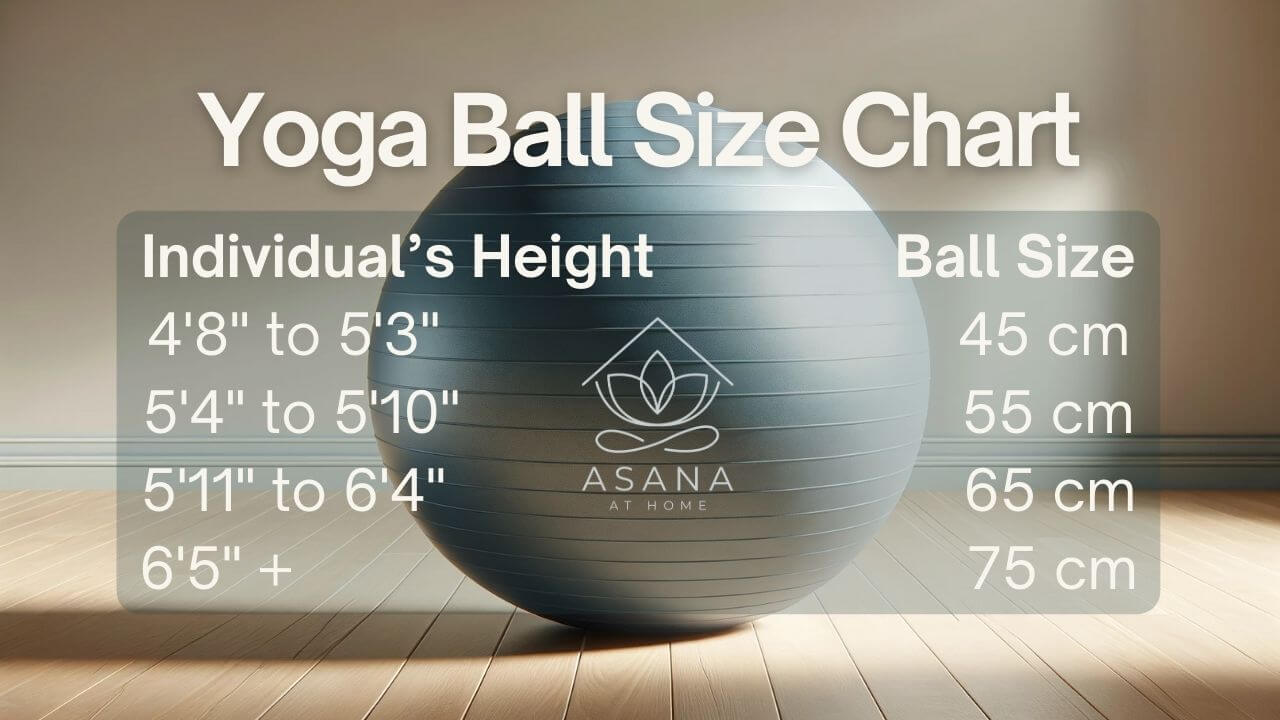
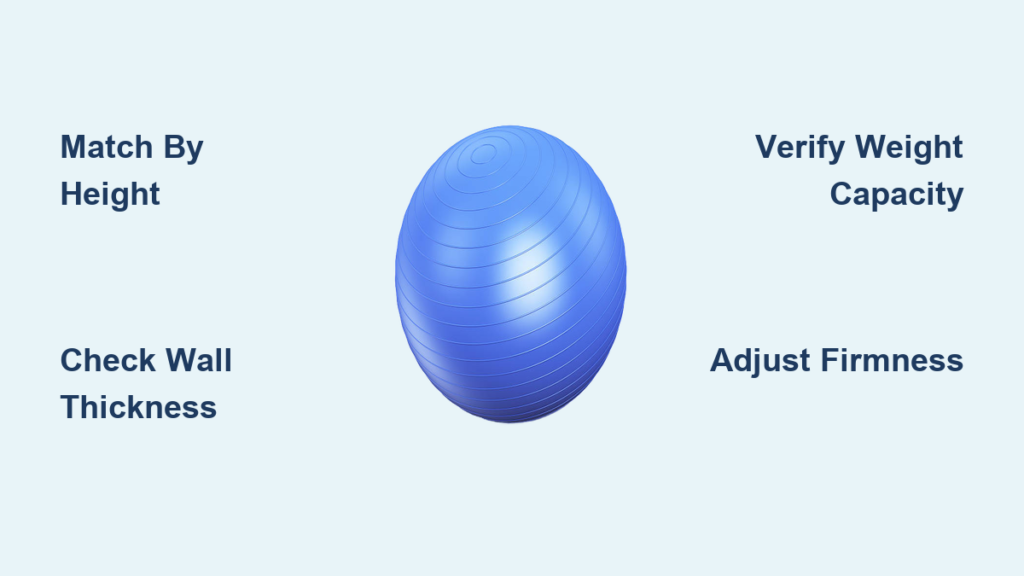
Your height directly determines which stability ball diameter will support proper alignment during exercises. Sitting on an incorrectly sized ball forces your joints into awkward positions that reduce workout effectiveness and increase injury risk. When positioned correctly, your knees should form a 90-degree angle with your thighs parallel to the floor and feet flat on the ground.
For adults under 5 feet tall, the 45-centimeter ball provides optimal support without causing excessive hip flexion. If you stand between 5 feet and 5 feet 7 inches—covering most women and shorter men—the 55-centimeter size delivers the ideal balance of stability and challenge for core exercises. Athletes and individuals between 5 feet 8 inches and 6 feet 2 inches need the 65-centimeter option to maintain proper posture during planks and roll-outs. Taller users over 6 feet 2 inches require the 75-centimeter diameter to prevent excessive hip flexion that strains the lower back during seated work.
How to Test Stability Ball Size Before Buying
When trying a stability ball in-store, perform this quick alignment check: Sit tall with your spine neutral and shoulders back. Your hips should sit level with or slightly above your knees. If you notice your knees rising above hip level, the ball is too small. When your thighs slope downward toward your knees, you’ve selected a ball that’s too large. Properly sized balls let you maintain balance without gripping with your thighs—your core should do the work, not your leg muscles.
What Happens When You Choose the Wrong Size
Using an undersized stability ball forces your knees higher than your hips, creating excessive pressure on your hip flexors and lower back. This position makes core exercises nearly impossible to perform with proper form. Oversized balls cause your thighs to angle downward, forcing you to slouch to maintain balance. This collapsed posture shifts the work away from your core muscles and toward your hip flexors, defeating the entire purpose of stability ball training.
Assess Material Quality: Beyond Basic PVC Construction

The stability ball’s material composition determines its longevity, safety, and how it feels against your skin during workouts. Premium balls use medical-grade PVC with anti-burst technology that slowly deflates rather than exploding if punctured—a critical safety feature for home use. Look for balls specifying “anti-burst” or “burst-resistant” construction rather than generic claims about durability.
Wall Thickness: The Hidden Factor in Ball Longevity
Wall thickness directly correlates with how long your stability ball will maintain proper inflation and resist punctures. Budget balls often feature 2mm walls that gradually lose air and develop weak spots near the valve. For regular home use, choose balls with at least 3mm wall thickness that maintain their shape through multiple inflation cycles. Serious athletes or heavier users should select 4mm+ construction that withstands intense pressure during advanced exercises like pikes or roll-outs.
Surface Texture: Grip vs. Comfort Trade-Offs
Smooth-surfaced stability balls work well for beginners but become slippery during sweaty sessions, forcing you to compensate with improper form. Textured surfaces provide superior grip during dynamic movements but can cause skin irritation during extended floor work. The ideal middle ground is a ball with subtle, uniform dimpling that enhances grip without creating pressure points against your spine during back extensions.
Verify Weight Capacity for Your Specific Needs

Every stability ball has a maximum weight rating that shouldn’t be treated as a suggestion. Exceeding this limit accelerates wear, causes premature deflation, and creates dangerous instability during exercises. Standard balls support 250-300 pounds, but if you weigh within 20 pounds of the limit, opt for a heavy-duty model rated for 500+ pounds that accounts for dynamic movement forces.
Office Use Requires Different Weight Considerations
When using a stability ball as a desk chair, continuous pressure creates different stress patterns than intermittent exercise use. Balls designed specifically for office work feature reinforced bases and often include non-slip bottoms that prevent rolling. Standard fitness balls used for sitting require 20% higher weight capacity than exercise-only models to maintain proper inflation throughout an 8-hour workday.
Match Firmness to Your Primary Workout Goals
Inflation level dramatically affects how your stability ball performs during different exercises. Most users under-inflate their balls, creating an unstable platform that makes basic exercises unnecessarily difficult. Proper firmness allows slight indentation when pressing with your thumb—about 1-2 inches of give under body weight.
Firmness Guidelines by Exercise Type
For strength-focused movements like chest presses or planks, inflate your ball until it feels solid but still yields slightly under pressure. This provides a stable platform that minimizes energy wasted on balance corrections. For balance and proprioception training, reduce inflation by 5-10% to increase instability and engage more core stabilizers. Never over-inflate beyond manufacturer recommendations—excessive pressure creates dangerous rigidity and increases burst risk.
Select Specialty Features Based on Actual Usage
While traditional round balls work for 90% of users, specialty designs solve specific problems. Half-moon stability balls feature a flat base that eliminates rolling during seated work, making them ideal for office use without sacrificing exercise functionality. These modified shapes provide progressive stability as you build core strength before transitioning to full-round balls.
When Specialty Balls Make Sense
Choose a medicine ball hybrid only if you regularly incorporate throwing movements into your routine. Resistance band attachments add versatility but create potential failure points—stick with a standard ball if you already own resistance bands. For post-rehabilitation work, look for softer density balls that provide gentle support during therapeutic movements without compromising stability.
Avoid Common Stability Ball Buying Mistakes
Many shoppers focus exclusively on size while ignoring critical factors that determine long-term satisfaction. Budget balls under $20 often use recycled materials that degrade quickly, causing uneven inflation and premature failure. Cheap valves become difficult to inflate after just a few uses and frequently develop slow leaks that ruin workout consistency.
Smart Investment Strategies
For most home users, a $30-$50 stability ball from established fitness brands delivers the best value. This price range includes proper anti-burst technology, adequate wall thickness, and reliable valves. Skip the ultra-cheap options—if the ball develops a persistent leak within six months, you’ve wasted money regardless of the initial price. Instead, invest in a quality ball that maintains proper inflation through hundreds of uses.
Final Selection Checklist Before Purchase
Before committing to a stability ball, verify these critical factors: First, confirm the exact diameter matches your height using the knee-hip alignment test. Second, check wall thickness—anything under 3mm won’t withstand regular use. Third, ensure the weight rating exceeds your body weight by at least 50 pounds for exercise use or 100 pounds for office sitting. Finally, test the surface texture against your forearm to verify comfort during extended contact.
Space Requirements and Storage Solutions
Measure your workout area before purchasing—fully inflated stability balls range from 17.7 inches (45cm) to 29.5 inches (75cm) in diameter. Consider whether you have space to store the ball inflated or need a model that deflates completely for closet storage. Some premium balls include carrying bags with shoulder straps that simplify storage, while others feature quick-deflate valves that reduce packing time from minutes to seconds.
The right stability ball becomes an indispensable fitness tool that enhances core strength, improves posture, and adds challenge to traditional exercises. By matching the size precisely to your height, verifying material quality, and selecting appropriate firmness for your goals, you’ll create a workout experience that’s both effective and enjoyable. Remember that the perfect stability ball feels challenging but not frustrating—when properly selected, it should enhance your form rather than compromise it. Take the time to choose carefully, and your stability ball will deliver years of reliable service across countless workouts.