Strong hamstrings are essential for everyday movements like walking, running, jumping, and climbing stairs. These posterior chain muscles work alongside your quadriceps, glutes, and calves to power nearly every lower body activity. Yet many people neglect their hamstrings, leading to muscle imbalances that increase injury risk and limit athletic potential. Learning how to strengthen hamstrings with resistance bands provides an accessible, affordable, and highly effective way to develop balanced leg strength regardless of your fitness level or equipment availability. This comprehensive guide will walk you through everything you need to know to build powerful, resilient hamstrings using nothing more than a simple elastic band.
Why Resistance Bands Target Hamstrings Effectively
The science behind resistance band training lies in the unique way these bands create tension. Unlike dumbbells where gravity provides resistance, bands offer variable resistance that increases as you stretch them further. This means your hamstrings work hardest at the point where they’re longest and most vulnerable to strain—the exact position where most injuries occur. By training your muscles under load at these extended positions, you build strength and resilience precisely where you need it most.
Resistance bands also allow for natural movement patterns that mimic real-world activities. Your hamstrings don’t work in isolation during daily movements; they function as part of an integrated system involving your hips, knees, and ankles. Band exercises respect these natural movement patterns while still providing sufficient overload to trigger strength adaptations. The instability introduced by bands also engages stabilizing muscles throughout your legs and core, creating more functional strength that transfers directly to athletic performance and everyday activities.
Another significant advantage is the mind-muscle connection that bands facilitate. The feedback from a band—knowing exactly when you’re losing tension or form—helps you maintain proper technique throughout each set. This heightened awareness leads to better muscle activation and more efficient workouts. Additionally, bands are incredibly portable, making them perfect for home workouts, travel, or outdoor training sessions where gym equipment isn’t available.
Essential Band Exercises for Hamstring Development
Banded Hamstring Curls for Maximum Muscle Activation
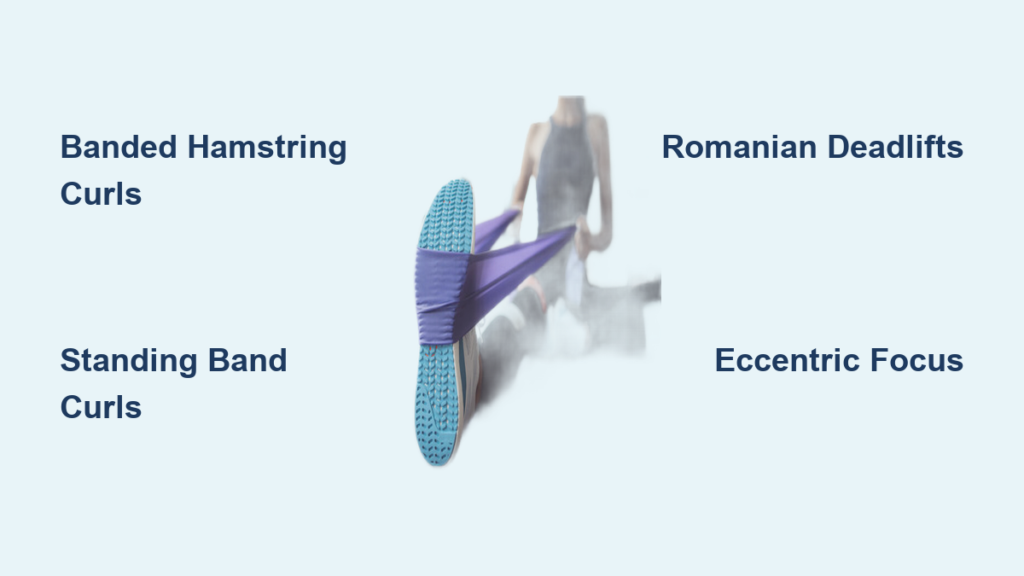
The banded hamstring curl is the foundational exercise for building hamstring strength with resistance bands. To perform this movement, secure the band around a sturdy anchor point at floor level—under a heavy piece of furniture, around a pole, or using a door anchor. Lie face down with your legs extended and the band looped around your ankles. Keep your hips pressed firmly into the floor as you curl your heels toward your glutes, squeezing your hamstrings at the top of the movement. Slowly return to the starting position with control, maintaining tension throughout the entire range of motion.
The key to maximizing this exercise lies in your anchor point distance and band placement. A further anchor point increases resistance throughout the movement, while a closer anchor makes the exercise easier. Start with a light band to master proper form before progressing to heavier resistance. Focus on initiating the curl from your hamstrings rather than momentum—your knees should bend smoothly rather than snapping back. Aim for 3 sets of 12-15 repetitions, concentrating on the eccentric (lowering) phase to build both strength and muscle control.
Standing Band Hamstring Curls for Functional Strength
Standing hamstring curls offer a different angle of attack that targets the hamstrings from a standing position, mimicking the functional role these muscles play in walking and running. Anchor the band behind you at approximately knee height, then face away from the anchor point with one leg stepping forward for stability. Loop the band around your ankle of the working leg, then curl your heel toward your glutes while keeping your upper body still. Hold the contracted position for one second before slowly extending your leg back to the starting position.
This single-leg variation helps identify and correct strength imbalances between legs, which is crucial for preventing injuries. The standing position also engages your core and hip stabilizers more intensely than the prone version, creating a more complete training effect. Perform 3 sets of 10-12 repetitions on each leg, resting 60 seconds between sets. As you develop strength, increase the band’s resistance or extend your anchor point distance to maintain progression.
Banded Romanian Deadlifts for Stretch Under Load

The Romanian deadlift variation with bands targets the hamstrings through a deep stretch while also engaging the glutes and lower back. Stand on the band with your feet shoulder-width apart, holding the handles or the band itself with a neutral grip. Hinge at your hips and push them backward, lowering the band toward the floor while maintaining a flat back. Go as far as your hamstring flexibility allows—typically around mid-shin level—then drive through your heels and squeeze your glutes to return to standing.
This exercise emphasizes the stretch under load that research has shown is crucial for muscle hypertrophy and hamstring injury prevention. The band’s resistance pattern actually complements this movement perfectly, providing more tension at the bottom of the lift when your hamstrings are longest. Keep your core engaged throughout the movement to protect your lower back, and avoid rounding your spine even as you reach deeper into the stretch. Complete 3 sets of 10-15 repetitions, focusing on a slow, controlled eccentric phase.
Proper Form and Technique for Maximum Results
Maintaining proper form throughout resistance band exercises is non-negotiable for achieving results and preventing injury. The most common technical error is using momentum rather than muscle force to complete repetitions. When you swing your body or use jerky movements, you reduce the tension on your target muscles while increasing stress on joints and connective tissues. Always prioritize smooth, controlled movements that keep your hamstrings under constant tension. If you cannot complete a repetition with proper form, the band is too heavy or you’re too fatigued—either rest or switch to a lighter resistance.
Hip positioning plays a critical role in hamstring activation during banded exercises. Many people allow their hips to rotate or lift during hamstring curls, which shifts work away from the target muscles and toward the lower back. During prone curls, press your hips firmly into the floor and maintain this contact throughout each set. During standing and hinge movements, keep your hips square and avoid excessive anterior pelvic tilt, which can strain the lumbar spine. Visualize your hamstrings doing the work—you should feel a strong contraction in the back of your thighs during every repetition.
Breathing properly during resistance training often gets overlooked but significantly impacts both performance and safety. Exhale during the concentric (shortening) phase of each movement—when you’re curling the band or lifting your hips—and inhale during the eccentric (lengthening) phase. This breathing pattern helps maintain core pressure, supports proper form, and delivers oxygen to working muscles. Avoid holding your breath, which can spike blood pressure and reduce muscular endurance.
Beginner to Advanced Training Progression
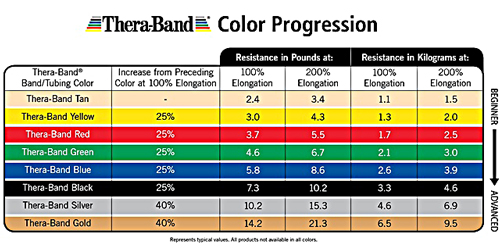
If you’re new to resistance band training, establishing a solid foundation with proper exercise technique and recovery habits will pay dividends throughout your training journey. Start with 2 sets of 12 repetitions of banded hamstring curls using a light band, resting 60-90 seconds between sets. Follow this with glute bridge with band for 2 sets of 15 repetitions, then finish with banded Romanian deadlifts for 2 sets of 10 repetitions. Perform this workout 2-3 times per week on non-consecutive days.
Once you’ve built a foundation, intermediate training introduces higher volume, multiple exercises per session, and shorter rest periods. Perform 3-4 hamstring exercises per session, completing 3-4 sets of each with 45-60 seconds rest between sets. Add standing band hamstring curls and single-leg deadlifts to your routine, performing these as complementary movements after the foundational exercises. Incorporate tempo manipulation—slowing the eccentric phase to 3-4 seconds—to increase time under tension and stimulate greater muscle growth.
Advanced trainees should incorporate periodized programming that cycles through phases of strength, hypertrophy, and power development. During strength phases, use heavier bands with lower repetitions (6-8 reps) and longer rest periods (2-3 minutes). During hypertrophy phases, use moderate resistance with moderate repetitions (10-15 reps) and moderate rest (60-90 seconds). Include explosive movements during power phases, focusing on velocity rather than maximal resistance.
Common Mistakes That Limit Results
Even experienced trainees frequently make errors that limit their hamstring development with resistance bands. One of the most prevalent mistakes is choosing bands that are too heavy. While heavier resistance might seem logical for building strength faster, it compromises form and reduces muscle activation. Start conservatively and progress systematically—your muscles respond better to perfect form with moderate resistance than sloppy form with maximum resistance.
Another common error is incomplete range of motion. Many people perform partial repetitions, especially during the stretched position where bands provide maximum resistance. This not only limits muscle development but also fails to build the flexibility and resilience you need in elongated muscle positions. Always complete full repetitions, moving through your full available range while maintaining control. The stretched position should feel challenging but never painful—if you experience sharp pain, reduce resistance or reassess your flexibility.
Neglecting the eccentric phase represents another significant missed opportunity. The lowering portion of each repetition is when muscle damage and subsequent hypertrophy occur most significantly. Count to three during eccentric phases, feeling your hamstrings lengthening under tension. Rushing through eccentric portions reduces training effectiveness considerably. Treat every repetition with equal attention to both lifting and lowering phases.
Preventing Hamstring Injuries with Band Training
Resistance band training offers unique benefits for hamstring injury prevention that extend beyond building raw strength. The eccentric-dominant nature of many band exercises strengthens the hamstrings specifically in the lengthened position where most strains occur. Research consistently shows that athletes who incorporate eccentric hamstring training experience significantly lower hamstring injury rates than those who focus only on concentric movements.
Band training also improves fascicle length and flexibility, which correlates directly with reduced injury risk. The deep stretch positions achieved during banded Romanian deadlifts and single-leg deadlifts lengthen the muscle fibers within your hamstrings, allowing them to absorb more force without sustaining damage. Maintain flexibility by including static stretching after your workouts, holding gentle stretches for 30-60 seconds while breathing deeply.
Progressive loading prepares your hamstrings for the demands of sport and daily activities. If you’re returning from a previous hamstring injury, start with very light resistance and high repetitions, gradually building tolerance before increasing intensity. Listen to your body—mild discomfort during stretching is normal, but sharp pain signals a problem that requires attention. Address imbalances promptly, as weakness or tightness on one side often leads to compensatory patterns that increase injury risk bilaterally.
Building stronger hamstrings with resistance bands requires consistent practice, proper technique, and strategic programming. By following these evidence-based methods, you’ll develop resilient, powerful posterior chains that support all your physical activities while reducing injury risk. Whether you’re a beginner or advanced trainee, resistance bands offer unparalleled versatility for hamstring development anywhere, anytime.