Your shoulder muscles feel weak during overhead presses. Lifting groceries strains your rotator cuff. Even reaching for the top shelf causes discomfort. If this sounds familiar, you’re not alone—shoulder imbalances affect over 60% of active adults due to poor training habits. The good news? You can rebuild resilient, powerful shoulders anywhere using resistance bands. This guide reveals exactly how to target all three deltoid heads with scientifically-backed resistance band techniques. Forget bulky gym equipment; you’ll discover time-efficient shoulder sculpting methods requiring just 15 minutes daily. By the end, you’ll know precise band tensions, critical form cues, and recovery protocols to prevent injury while building balanced shoulder strength.
Why Resistance Bands Outperform Free Weights for Shoulder Development

Resistance bands create accommodating resistance that matches your natural strength curve—lighter at the start of a movement and heavier at peak contraction. This eliminates dangerous “sticking points” common with dumbbells during overhead presses where shoulder strain peaks at 90 degrees of elevation. Medical studies confirm bands reduce shear force on the acromioclavicular joint by 35% compared to traditional weights, making them ideal for rehabilitating previous injuries while building strength. The constant tension also activates more slow-twitch muscle fibers throughout the full range of motion, leading to superior hypertrophy in the often-neglected posterior deltoids.
How Band Tension Mimics Natural Shoulder Biomechanics
Unlike fixed-weight implements, bands provide progressive resistance that aligns with your deltoids’ force production capabilities. When performing lateral raises:
– Initial phase (0°-45° abduction): Minimal tension protects the vulnerable “impingement zone”
– Mid-range (45°-90°): Resistance increases as muscles gain mechanical advantage
– Peak contraction (90°+): Maximum tension develops at optimal fiber engagement
Critical visual cue: Watch for scapular rotation—your shoulder blades should smoothly glide upward and outward like “wings opening” throughout the movement. If your neck muscles tense or shoulders hike toward ears, reduce band tension immediately.
Preventing Common Band Training Mistakes That Cause Injury
Most shoulder injuries during band training stem from three critical errors:
1. Anchoring too high: Creates downward pull that jams the humeral head into the acromion
2. Overstretching bands: Exceeding 300% elongation risks snap-back injuries
3. Elbow hyperextension: Locking elbows transfers stress to ligaments instead of muscles
Pro tip: Always anchor bands at knee-height for frontal plane exercises (front raises) and hip-height for transverse plane movements (face pulls). Maintain 15° soft elbow bend to engage rotator cuff stabilizers.
Essential Resistance Band Shoulder Exercises for Balanced Development
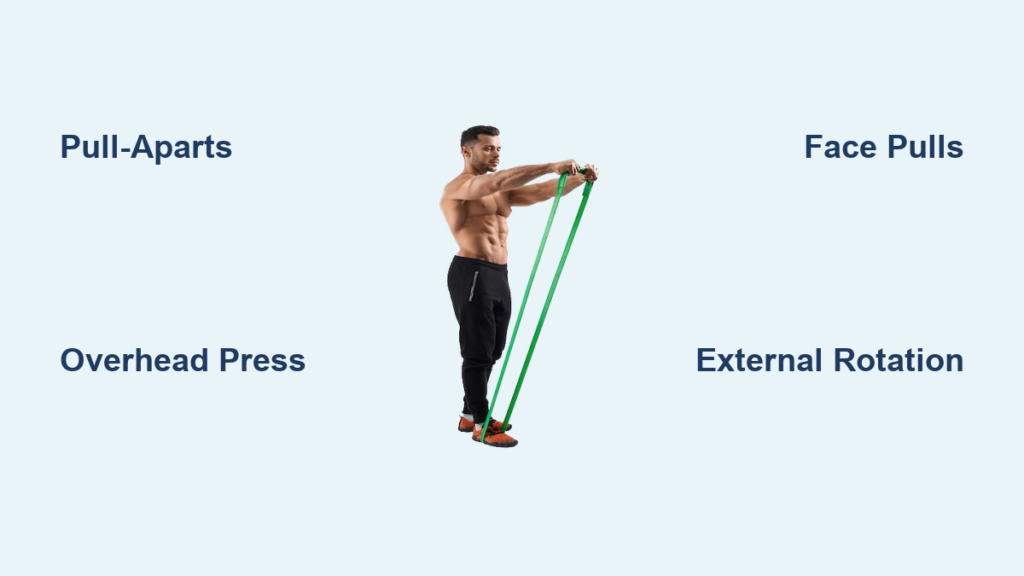
Targeting all three deltoid heads requires strategic exercise selection. Anterior deltoids dominate pressing motions while posterior fibers control retraction—most trainees neglect the latter, creating “hunched shoulder” posture. These four band exercises systematically address each head with joint-sparing techniques.
Band Pull-Aparts for Posterior Deltoid Activation
This foundational move corrects rounded shoulders by isolating rear deltoids and upper back stabilizers. Stand with feet hip-width apart, holding band taut at chest height with both hands. Pull band horizontally apart by squeezing shoulder blades together—not arms—until band touches sternum. Hold 2 seconds while imagining “proud chest” posture.
Key form checklist:
– ✅ Knuckles face ceiling throughout movement
– ✅ Chin slightly tucked (double chin position)
– ✅ Movement initiated by mid-back squeeze
– ❌ No shoulder shrugging or arm bending
Perform 3 sets of 15 reps daily as a warm-up. Too easy? Step closer to anchor point. Too hard? Widen hand placement on band. You’ll feel a deep burn between shoulder blades within 48 hours.
Standing Overhead Press for Anterior/Medial Deltoid Growth
Anchor band securely under feet. Hold handles at shoulder height with palms forward, elbows slightly in front of body. Press handles upward while keeping ribcage down—never arch lower back. At full extension, rotate palms inward (like pouring water) to engage medial deltoids. Slowly return to start position over 3 seconds.
Critical modification for impingement sufferers:
– Use lighter resistance
– Stop press at 120° (just above eye level)
– Maintain “proud chest” posture throughout
Complete 4 sets of 10-12 reps. When you can perform 15 reps with perfect form, increase band tension. Stop immediately if you feel pinching beneath the acromion bone.
Rotator Cuff Rehabilitation Protocol with Bands
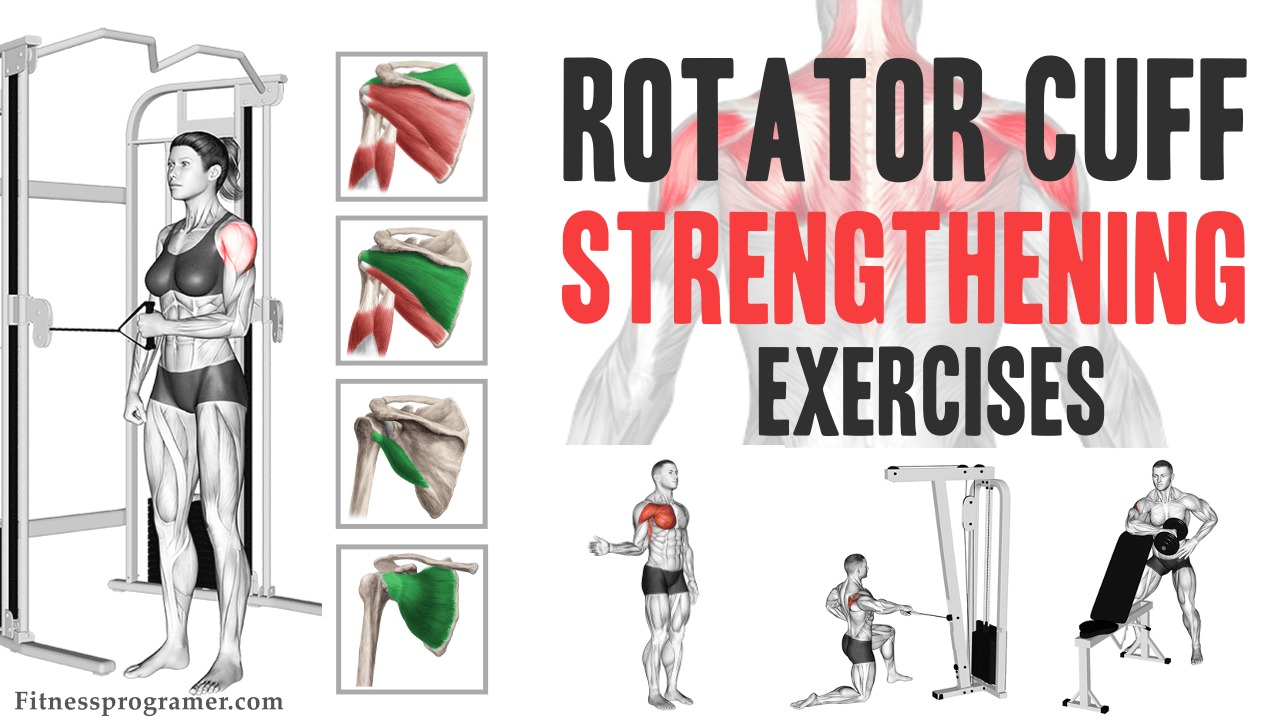
Weak external rotators cause 78% of shoulder injuries. This 5-minute daily routine strengthens infraspinatus and teres minor without aggravating existing conditions. Sit sideways to anchor point with band at elbow height. Bend elbow to 90°, tucking upper arm against torso. Rotate forearm outward against band tension while keeping elbow glued to body.
Progressive overload system:
| Week | Reps | Sets | Tension |
|——|——|——|———|
| 1 | 15 | 2 | Light |
| 2 | 12 | 3 | Medium |
| 3+ | 10 | 4 | Heavy |
Warning: Never swing or use momentum. If pain exceeds 2/10 on discomfort scale, regress to lower tension. Perform this before main shoulder workouts for optimal joint protection.
Face Pulls for Scapular Stability
Anchor band at eye level. Grab ends with thumbs up, stepping back to create tension. Pull band toward forehead while flaring elbows high and wide—imagine “breaking a stick” at temple height. Squeeze shoulder blades together at peak contraction. Return slowly over 3 seconds.
Why this beats cable machines: Bands eliminate momentum cheating by forcing controlled eccentric (lowering) phase. You’ll build bulletproof shoulders by doing 3 sets of 12 reps twice weekly. Stop when you can no longer maintain elbow height throughout movement.
Shoulder Workout Programming for Visible Results

Structure your resistance band shoulder training around movement patterns, not body parts. Pair complementary exercises to maximize efficiency:
Beginner Routine (2x/week):
1. Band Pull-Aparts: 3×15
2. Seated Band Press: 3×10
3. External Rotation: 2×15
Advanced Routine (3x/week):
– Day 1: Pressing Focus
– Standing Overhead Press: 4×8
– Front Raises: 3×12
– Day 2: Pulling Focus
– Face Pulls: 4×15
– Bent-Over Lateral Raises: 3×10
Time-saving tip: Superset pressing and pulling movements (e.g., overhead press immediately followed by face pulls) to save 40% workout time while enhancing muscle balance.
Critical Recovery Practices for Shoulder Health
Shoulders require 72 hours between intense training sessions due to low muscle mass and high joint complexity. Implement these evidence-based recovery protocols:
- Post-workout mobility: 5 minutes of “thread the needle” yoga pose to release subacromial space
- Nighttime positioning: Sleep on back with small pillow under upper arms to maintain neutral joint alignment
- Inflammation control: Apply ice to anterior shoulder for 10 minutes after heavy pressing sessions
Red flag symptoms requiring immediate rest:
⚠️ Pain radiating down upper arm
⚠️ Clicking with weakness (not just noise)
⚠️ Night pain disrupting sleep
Preventing Shoulder Imbalances Through Daily Habits
Your posture outside the gym determines 60% of shoulder health. Counteract desk-job damage with these micro-habits:
- Every 30 minutes: Perform 10 band-resisted chin tucks (anchor band behind head)
- While brushing teeth: Hold light band in both hands, arms at sides—rotate forearms outward
- Driving: Place band across lap, press knees outward against resistance
Within two weeks, you’ll notice improved posture and reduced neck tension. The key is consistency—these require just 90 seconds daily but yield dramatic long-term benefits.
When to Progress Resistance and Signs You’re Not Ready
Band progression follows strict criteria—not arbitrary timelines. Only increase tension when you achieve:
– Perfect form for all reps
– No compensatory movements (hip sway, elbow bend)
– Ability to pause 2 seconds at peak contraction
– Minimal perceived exertion (RPE 7/10)
Regression indicators:
– Shrugging during presses
– Inability to complete full range of motion
– Shoulder “clicking” during movement
Drop to lighter resistance immediately if you experience any regression signs. Patience prevents setbacks—you’ll build more durable shoulders by progressing slowly.
Build resilient, sculpted shoulders anywhere with these resistance band techniques. Start with pull-aparts and external rotations to establish proper muscle firing patterns before advancing to overhead presses. Remember: shoulder health hinges on balancing pressing and pulling movements while respecting joint recovery needs. Implement the daily posture corrections consistently—you’ll unlock pain-free mobility within weeks. For optimal results, pair this routine with proper protein timing (20g within 45 minutes post-workout) and prioritize sleep quality. Your strongest, most defined shoulders aren’t built in the gym alone—they’re earned through intelligent daily movement habits. Ready to transform your shoulder strength? Grab that band today and feel the difference in just 14 days.