You’ve just unboxed your new parallettes and they’re sitting in the corner of your room, but you’re not sure where to start. Many fitness enthusiasts make the mistake of jumping straight into advanced moves without mastering foundational techniques, leading to frustration or even injury. Without proper guidance, your parallettes can quickly become expensive decor rather than a powerful fitness tool. This guide delivers the exact techniques you need to transform your parallettes from intimidating equipment into your most valuable training asset—no prior gymnastics experience required.
Parallettes training builds incredible upper body strength, shoulder stability, and core control that translates to better performance in nearly every other exercise. Whether you’re recovering from shoulder issues, building toward handstands, or simply want to add variety to your workout routine, understanding proper parallettes usage is the gateway to unlocking your full potential. By the end of this guide, you’ll know exactly how to position your hands, progress safely through foundational movements, and avoid the most common mistakes that stall beginners’ progress.
Proper Parallettes Setup and Hand Placement

How to Position Your Parallettes for Maximum Stability
Place your parallettes shoulder-width apart with the handles parallel to each other for most foundational exercises. The ideal width allows your elbows to stay close to your body during movements rather than flaring outward. For beginners, position them slightly wider than shoulder-width to reduce strain on the shoulders while learning proper form. Check that both units sit firmly on the ground without wobbling—if they rock even slightly, adjust your surface or equipment placement immediately.
Critical mistake to avoid: Placing parallettes too close together forces excessive wrist extension, while positioning them too wide compromises shoulder stability. Your knuckles should face forward with fingers wrapped securely around the bars, not resting on top where they could slip during movement.
Perfect Hand Positioning for Injury Prevention
Grip the parallettes with your palms facing each other, fingers wrapped around the outside of the bars. Your wrists should maintain a neutral position—neither bent backward nor forward—as if you’re shaking hands with the equipment. Press through your entire palm, not just your fingers, to distribute weight evenly across your hand. Imagine screwing your hands into the ground to activate your forearm muscles and create a stable base.
Pro tip: Place small pieces of athletic tape where your hands naturally fall on the bars to maintain consistent positioning across workouts. This subtle marker helps prevent hand drift that can lead to uneven weight distribution.
Foundational Parallettes Exercises for Beginners
Parallettes Push-Ups: The Essential Starting Point
Begin with your hands firmly on the bars, body in a straight line from head to heels. Lower yourself until your elbows reach 90 degrees, keeping them tucked at a 45-degree angle to your body. Push through your palms to return to the starting position, fully extending your arms without locking your elbows. Complete 3 sets of 8-12 repetitions, resting 60 seconds between sets.
Visual cue: Watch your elbow position in a mirror—your elbows should stay aligned with your wrists throughout the movement, not traveling past your hands at the bottom position.
How to Perform Proper Parallettes Planks for Core Development
Mount the parallettes with both hands, stepping back into a plank position while maintaining a neutral spine. Engage your core by drawing your belly button toward your spine and squeezing your glutes. Hold this position for 20-30 seconds while breathing steadily, ensuring your hips don’t sag or rise too high. Repeat for 3-4 sets with 30 seconds rest between holds.
Common mistake: Beginners often let their hips drop toward the floor, shifting weight to their shoulders instead of engaging their core. If you can’t maintain proper form, drop to your knees temporarily while building strength.
Intermediate Parallettes Progressions

L-Sit Fundamentals on Parallettes
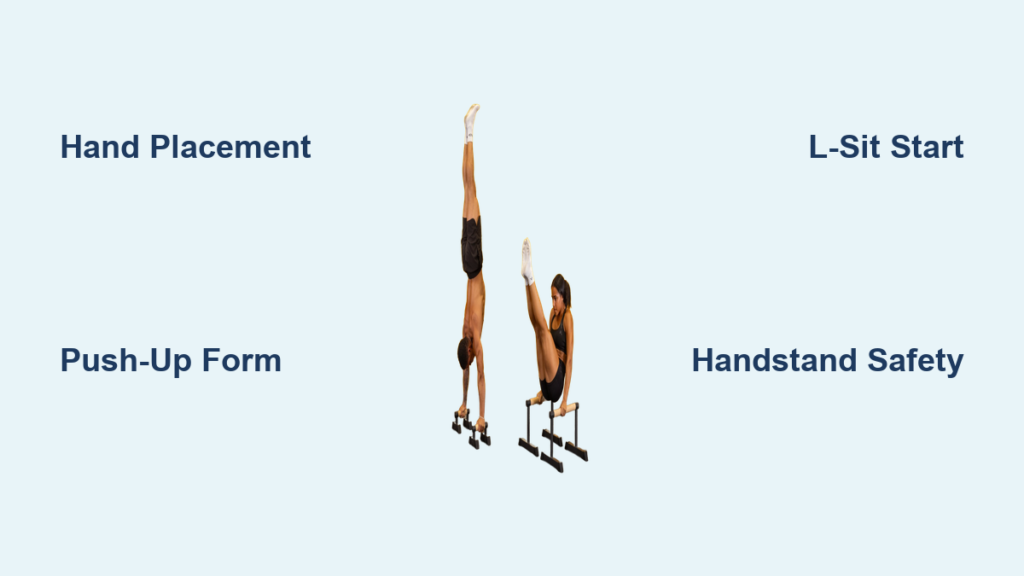
Start from a seated position on the floor with parallettes positioned at shoulder width. Place your hands on the bars, fingers forward, then lift your hips off the ground while extending your legs straight in front of you. Keep your arms straight and shoulders engaged as you hold this position. Beginners should aim for 10-15 second holds for 3 sets, gradually increasing duration as strength improves.
Progression path: Once you can hold a solid 20-second L-sit, try bending your knees slightly to increase the challenge. Only progress to straight legs when you’ve mastered the bent-knee variation with perfect form.
How to Safely Practice Handstand Holds on Parallettes
Position yourself between the parallettes near a wall for support. Kick up gently while keeping your gaze between your hands, not looking directly down. Once balanced, engage your core and squeeze your glutes to maintain a straight line from hands to feet. Beginners should start with 5-10 second holds against the wall, completing 5-8 repetitions with full rest between attempts.
Critical safety note: Always practice near a wall when learning handstands, and never attempt to “catch” yourself by moving the parallettes—let go and step down if you feel yourself falling forward.
Advanced Parallettes Techniques
Muscle-Up Progression on Parallettes
Begin in a dead hang position with arms fully extended. Pull yourself up explosively while simultaneously driving your knees toward your chest. As your chest reaches bar height, rotate your wrists outward and press through your palms to lock out in a support position. Practice the transition phase separately by jumping to the top position and lowering slowly.
Time investment: Most trainees require 4-8 weeks of dedicated progression work before achieving their first clean parallettes muscle-up. Don’t rush this movement—master each component before attempting the full exercise.
How to Master Planche Leans on Parallettes
Place your hands on the parallettes slightly wider than shoulder width, walk your feet back while keeping your body straight. Shift your weight forward until your shoulders pass your wrists, maintaining a straight line from hands to feet. Hold this position for 10-20 seconds, completing 3-5 sets with full recovery between attempts.
Form checkpoint: If your hips sag or your lower back arches, you’ve shifted too far forward. Reset to a more vertical position and gradually increase your lean as strength improves.
Common Parallettes Training Mistakes to Avoid
Wrist Position Errors That Cause Pain
Many beginners place excessive weight on their fingers rather than distributing pressure through the entire palm. This concentrates force on the wrist joint, causing unnecessary strain. Keep your weight centered in your palms with fingers wrapped securely around the bars, not resting on top where they could slip.
Immediate fix: If you experience wrist discomfort, reduce your range of motion temporarily and incorporate wrist mobility exercises before and after your parallettes sessions.
Incorrect Breathing Patterns During Exercises
Holding your breath during parallettes exercises increases blood pressure and reduces stability. Proper breathing maintains core tension and oxygen flow to working muscles. Exhale during the concentric (pushing/upward) phase and inhale during the eccentric (lowering/downward) phase of each movement.
Training drill: Practice breathing patterns separately by performing movements at 50% intensity while focusing solely on proper respiration rhythm before adding full effort.
Parallettes Training Programming Essentials
How to Structure Your Weekly Parallettes Routine
Beginners should train parallettes 2-3 times weekly with at least one full rest day between sessions. Start each workout with 5-10 minutes of wrist and shoulder mobility work before progressing to skill development and strength exercises. Limit skill work to 15-20 minutes per session to prevent fatigue-related form breakdown.
Sample beginner schedule:
– Monday: Push-ups, planks, handstand practice
– Wednesday: Rest or light mobility
– Friday: Push-ups, L-sit progressions, planks
Progressive Overload Strategies for Continued Improvement
Track your progress by timing holds, counting repetitions, or noting reduced assistance needed for each exercise. Increase difficulty only when you can complete all prescribed sets with perfect form. For push-up variations, add difficulty by slowing the tempo or elevating your feet. For static holds, increase duration by 5-10% weekly.
Warning: Avoid the temptation to rush progressions—spending adequate time mastering each stage prevents plateaus and injuries down the road.
Essential Maintenance and Care for Your Parallettes
How to Keep Your Parallettes in Optimal Condition
Wipe down your parallettes with a dry cloth after each use to remove sweat and prevent grip deterioration. Store them horizontally on a flat surface rather than standing vertically, which can cause warping over time. Check all connection points regularly if using adjustable models to ensure stability during use.
Longevity tip: For wooden parallettes, occasionally apply food-grade mineral oil to maintain the wood’s integrity and prevent cracking, especially in dry climates.
Final Note: Consistent parallettes training builds functional strength that enhances performance across all fitness disciplines. Start with proper hand placement and foundational movements before progressing to advanced techniques. Listen to your body’s feedback—discomfort is normal during adaptation, but sharp pain indicates you should stop and reassess your form. Incorporate parallettes into your routine 2-3 times weekly, focusing on quality over quantity, and you’ll develop impressive upper body control that translates to every aspect of your training. For continued progress, revisit foundational movements periodically to ensure you maintain proper technique as you advance to more challenging exercises.