You’ve probably seen those colorful elastic bands at the gym or in workout videos, but learning how to use resistance bands for beginners can feel overwhelming at first. These versatile fitness tools have transformed home workouts by making strength training accessible to everyone, regardless of experience or available space. Unlike traditional weights, resistance bands provide progressive tension that increases as you stretch them, challenging your muscles throughout the entire movement. This unique feature makes them perfect for beginners who want to build strength safely without intimidating gym equipment.
The beauty of resistance band training lies in its simplicity and effectiveness. As you stretch the band, the resistance grows stronger, creating maximum tension precisely when your muscles need it most. This variable resistance pattern develops balanced strength while protecting your joints—ideal for those just starting their fitness journey. Plus, a complete set of bands costs less than a single gym membership fee and fits in a small bag, making them perfect for home workouts, travel, or outdoor training sessions.
This guide cuts through the confusion and gives you exactly what you need to know to start using resistance bands effectively. You’ll discover which bands to choose, how to perform exercises with proper form, and simple workout routines that deliver real results. By the time you finish reading, you’ll feel confident enough to unroll your first band and begin building strength today.
Why Resistance Bands Are Perfect for New Trainers
Resistance bands offer game-changing advantages that make them ideal for beginners stepping into strength training. Unlike free weights that rely entirely on gravity and can cause injury if dropped, bands generate resistance through your movement, allowing for controlled exercises that build functional strength while protecting your joints. This controlled environment helps you develop proper form without the fear of heavy weights causing harm.
One of the most significant benefits is the enhanced muscle activation bands provide. Research shows they activate muscles comparably to free weights while recruiting more stabilizer muscles due to the constant tension requirement. This means you develop better overall functional strength that translates directly to real-world activities—like carrying groceries or climbing stairs—rather than isolated strength that doesn’t transfer to daily life.
Their versatility is unmatched for beginners. A single band can replace multiple pieces of gym equipment, enabling you to perform hundreds of exercises targeting every major muscle group. This comprehensive approach means you can create complete workout programs without ever setting foot in a gym. The portability factor amplifies this benefit—you can maintain your fitness routine while traveling, in a hotel room, or even in a small apartment.
Selecting Your First Resistance Band Set
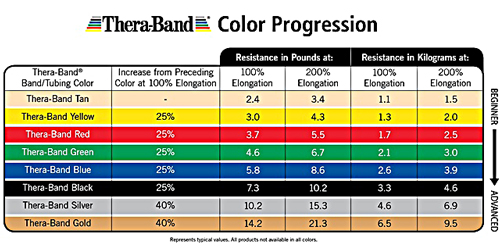
Choosing the right resistance level makes or breaks your beginner experience. Bands typically come in color-coded levels corresponding to resistance intensity, though different manufacturers use varying color schemes.
- Light resistance (yellow/gold): Provides 2-5 pounds of resistance, ideal for rehabilitation, seniors, or those with very limited strength
- Medium resistance (green/blue): Offers 5-15 pounds of resistance, suitable for most healthy beginners
- Heavy resistance (red/black): Delivers 15-30+ pounds of resistance, appropriate as you progress
Start with a three-band set covering light, medium, and heavy resistance. This gives you flexibility to choose appropriate resistance for different muscle groups—lighter bands for upper body exercises, heavier bands for lower body movements. Your first workout should use medium resistance for most exercises, switching to lighter bands if you struggle with proper form.
Essential Setup for Safe Band Training
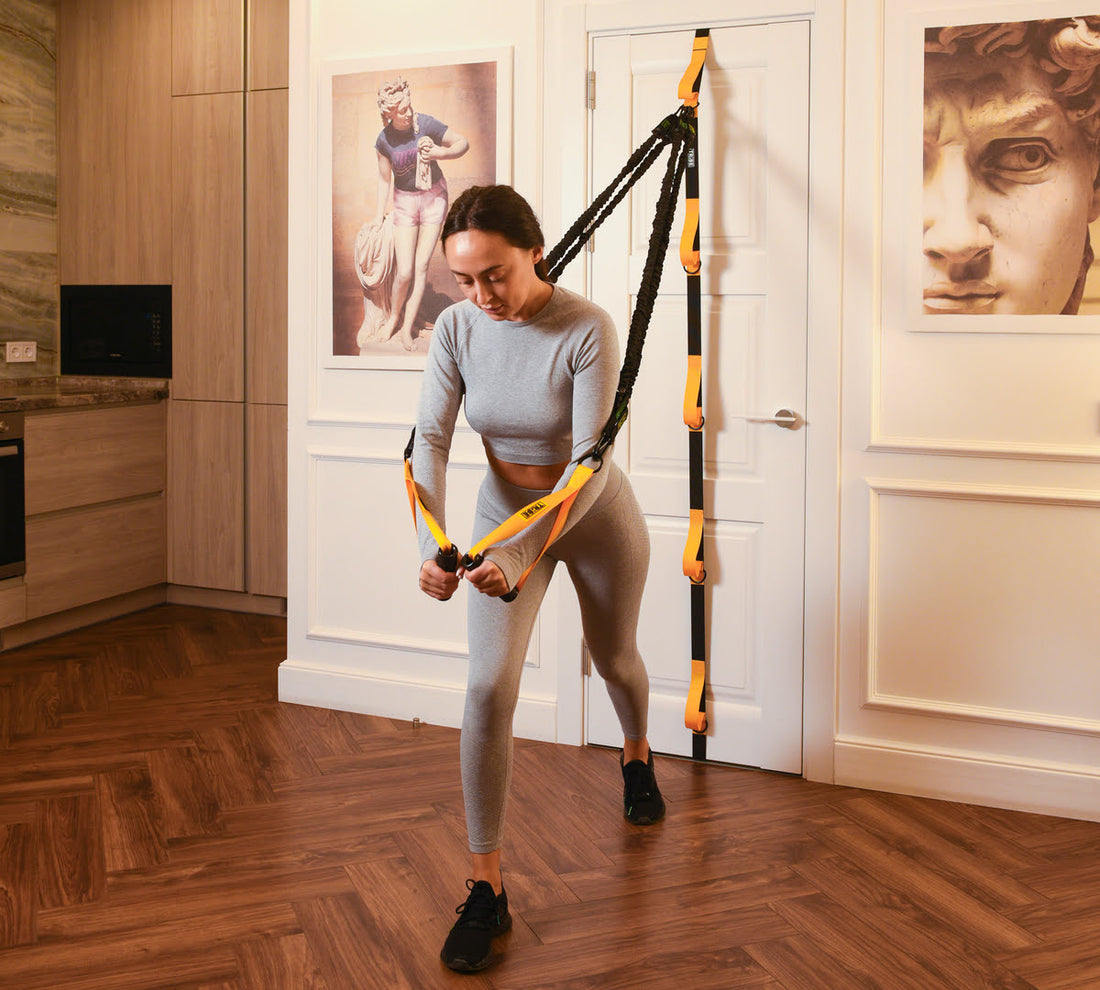
Before performing your first exercise, ensure you have proper equipment and space setup:
Anchor points are crucial for many band exercises. Door anchor attachments provide secure connection points that fit in standard doorjambs. Always verify the door closes completely and test the anchor’s security by applying light tension before committing to full resistance. Alternative anchor points include sturdy poles, heavy furniture, or trees for outdoor training.
Handle attachments improve comfort during pulling or pressing movements, while ankle straps secure bands for lower body exercises like hip abductions. These accessories expand your exercise options significantly.
Your training surface should provide adequate cushioning—yoga mats work excellently, while carpeted surfaces offer sufficient padding for most home workouts. Ensure your space has enough room to perform exercises without the band catching on nearby objects.
Perfect Your Resistance Band Form in 4 Steps
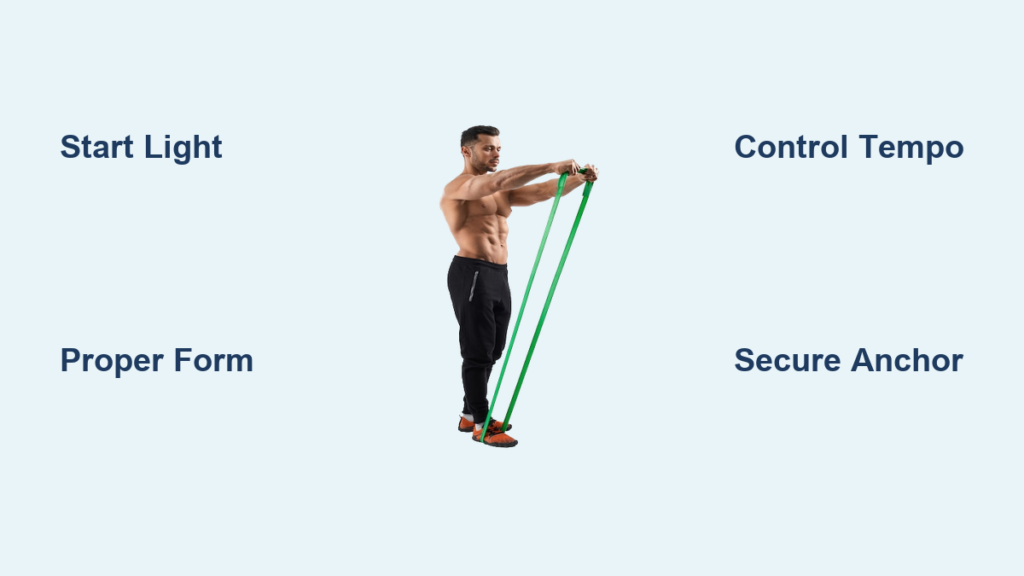
Mastering proper technique prevents injury and maximizes results during resistance band training. Follow these four fundamentals:
Grip technique matters more than beginners realize. Wrap the band around your hand or hold it with a closed fist to prevent slipping. Different exercises require different grips—overhand for rows, underhand for bicep curls, neutral for shoulder presses. When holding with both hands, position them shoulder-width apart unless specified otherwise.
Maintain spinal alignment throughout every exercise. Keep your spine neutral (avoid excessive arching or rounding), engage your core to stabilize your torso, and keep shoulders down and back—away from your ears. For standing exercises, distribute weight evenly between both feet with a slight knee bend.
Control your movement tempo for maximum benefit. Take 2-3 seconds during the concentric phase (muscle shortening) and 3-4 seconds during the eccentric phase (muscle lengthening). Never let the band snap back—maintain tension throughout the entire range of motion.
Breathe properly to support performance and safety. Exhale during the effort phase (working against resistance) and inhale during the return phase. Avoid holding your breath, which spikes blood pressure and reduces performance capacity.
3 Must-Know Upper Body Exercises for Beginners
Start with these foundational upper body movements that build strength safely:
Band Chest Press: Anchor the band at chest height behind you, grasp handles, and step forward to create tension. Press hands forward until arms nearly straighten, then return with control. Keep core engaged and avoid arching your back. Perform 2 sets of 12-15 repetitions.
Band Row: Anchor band at chest height in front, grasp handles, and sit with legs extended. Pull handles toward your torso by bending elbows and squeezing shoulder blades together. Extend arms to return. Complete 2 sets of 12-15 repetitions with an upright torso.
Band Bicep Curl: Stand on band center with feet hip-width apart, holding handles with palms forward. Curl hands toward shoulders while keeping elbows close to your torso. Lower with complete control. Perform 2 sets of 12-15 repetitions without swinging your body.
3 Essential Lower Body Exercises for New Users
These foundational lower body exercises build functional strength safely:
Band Squat: Stand on band with feet shoulder-width apart, holding handles at shoulder height. Lower as if sitting into a chair while keeping chest lifted and knees tracking over toes. Drive through heels to stand, squeezing glutes at the top. Perform 2 sets of 12-15 repetitions.
Band Deadlift: Stand on band with feet hip-width apart, holding handles with arms extended. Hinge at hips while keeping back flat, lowering handles along legs. Push through heels to return, squeezing glutes at the top. Complete 2 sets of 10-12 repetitions.
Band Glute Bridge: Lie on back with knees bent, placing band above knees. Press knees outward against resistance while lifting hips toward ceiling. Squeeze glutes at the top before lowering. Perform 2 sets of 15-20 repetitions.
Core Training Made Simple with Bands
Build core stability with these beginner-friendly exercises:
Band Pallof Press: Anchor band at chest height, grasp handle with both hands. Step perpendicular to anchor point, extend arms straight out, and hold briefly against rotational pull. Return with control. Complete 2 sets of 10-12 repetitions per side.
Band Wood Chop: Anchor band high, grasp handle with both hands. Pull band diagonally across body from high anchor point to opposite hip. Return with control. Perform 2 sets of 10-12 repetitions in each direction.
Band Russian Twist: Sit with knees bent, holding band handle. Lean back slightly and rotate torso side-to-side while keeping hips stable. Complete 2 sets of 15-20 total rotations.
Follow This Beginner Band Workout Plan
Start with this simple full-body routine 2-3 days weekly:
- Warm up 5-10 minutes with light cardio and dynamic stretches
- Band Chest Press: 2 sets of 12-15 reps
- Band Row: 2 sets of 12-15 reps
- Band Squat: 2 sets of 12-15 reps
- Band Shoulder Press: 2 sets of 10-12 reps
- Band Deadlift: 2 sets of 10-12 reps
- Band Bicep Curl: 2 sets of 12-15 reps
- Cool down with static stretching for 5-10 minutes
Rest 60-90 seconds between sets. Focus on perfect form rather than speed or resistance level. Complete this routine consistently for 4-6 weeks before progressing.
Avoid These 5 Common Beginner Mistakes
Using bands that are too heavy compromises form and increases injury risk. Start lighter than you think you need—proper technique matters more than resistance level.
Poor anchor point security creates dangerous situations. Always test anchor points thoroughly before applying full tension, and never attach bands to unstable objects.
Letting bands snap back carelessly can cause injury. Maintain control throughout the entire range of motion and release tension slowly when ending exercises.
Neglecting the eccentric phase limits results. Take time to lower resistance with control rather than letting the band pull you back quickly.
Improper joint alignment causes unnecessary stress. Keep knees tracking over toes during lower body exercises and avoid locking elbows during pressing movements.
Progress Your Band Training Safely
As your strength develops, use these progression methods:
- Increase resistance only when you can complete all reps with proper form (typically after 4-6 weeks)
- Add sets before increasing resistance—progress from 2 to 3 sets per exercise
- Decrease rest periods from 90 seconds to 60 seconds between sets
- Increase repetitions within the recommended range before adding sets or resistance
Remember: Never progress multiple variables at once. Choose one progression method and master it before moving to the next.
Extend Your Bands’ Lifespan with Proper Care
Maximize your investment with these care tips:
Store bands in cool, dry locations away from direct sunlight, which degrades materials. Keep them coiled or rolled neatly—never store in compressed states. Clean bands regularly with a damp cloth and mild soap to remove sweat and oils that accelerate degradation. Inspect bands before each use for signs of wear, tears, or thinning material, and replace any damaged bands immediately.
Learning how to use resistance bands for beginners opens a world of fitness possibilities that fit any lifestyle, space, or budget. These versatile tools provide everything you need to build strength, improve muscle tone, and develop functional fitness without expensive gym equipment. The key to success lies in starting with appropriate resistance, mastering proper form, and progressing gradually as your strength develops. With consistent practice using these techniques, you’ll build a strong foundation that supports your fitness journey for years to come.