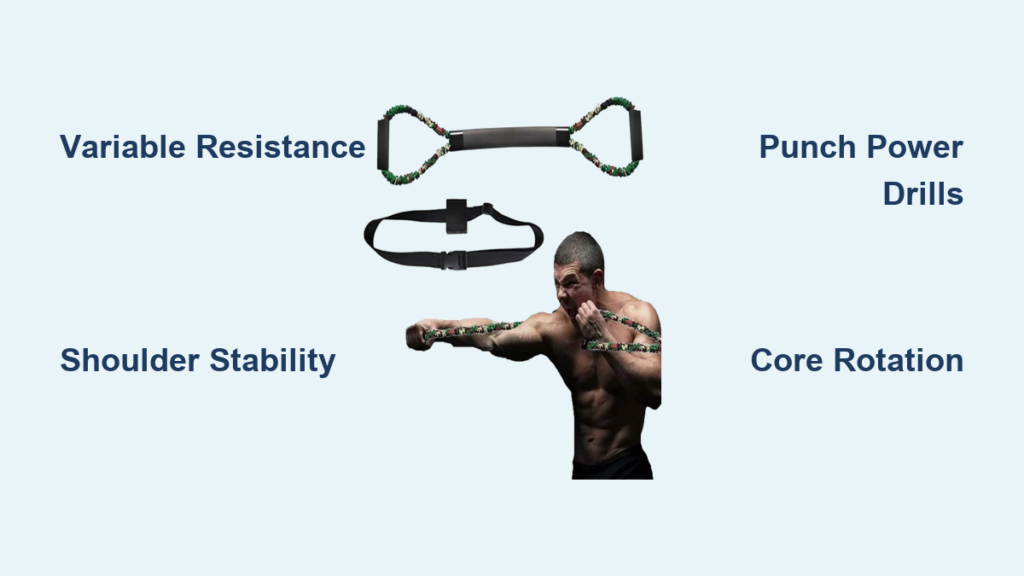
You’re throwing punches with perfect technique, but your power seems to plateau. Your shoulders ache after intense sparring sessions, and late-round fatigue leaves your combos feeling sluggish. What if you could develop knockout power, bulletproof shoulders, and championship stamina—all without heavy weights or expensive gym equipment? Learning how to use resistance bands for boxing unlocks a training method that directly translates to ring performance. Unlike traditional weights that offer constant resistance, bands provide variable tension that increases as you punch, mirroring the exact force curve needed for explosive boxing combinations.
Portable, affordable, and scientifically proven to enhance punching mechanics, resistance bands have become essential tools for fighters at every level. Whether you’re a beginner building foundational strength or a professional fine-tuning fight-specific power, band training develops the critical connection between your lower body drive and upper body snap that separates powerful punchers from average fighters. This guide reveals the exact protocols, exercises, and programming strategies that transform your punching power while protecting your shoulders from the repetitive stress of boxing training.
Why Boxers Need Resistance Band Training That Actually Works
Resistance bands deliver variable resistance that increases as you extend your punch—perfectly matching the force requirements of actual punching mechanics. Traditional weights create constant resistance that feels heaviest at the start of your punch when your muscles are weakest, but bands provide lighter resistance at the beginning of your punch and increase as you extend, where you naturally generate more power. This training specificity develops the fast-twitch muscle fibers responsible for explosive punching velocity while teaching your nervous system to accelerate through full range of motion—the exact skill that creates knockout power.
How Variable Resistance Matches Punching Mechanics
When you throw a jab against band resistance, you experience minimal tension at the start of your punch (when your shoulder is internally rotated and muscles are mechanically disadvantaged) with resistance progressively increasing as your arm extends. This matches the natural force curve of punching, where maximum power generation occurs during the final portion of the movement. The result? Your muscles learn to accelerate through the entire punch rather than slowing prematurely—a common issue with weight training that creates “stiff” punching mechanics. Proper band resistance should feel challenging but not overwhelming at full extension, allowing you to maintain proper technique while building power.
The Shoulder Stability Advantage for Fighters
Boxers suffer shoulder injuries at alarming rates due to repetitive punching stress and muscle imbalances. Resistance bands solve this by strengthening the rotator cuff and scapular stabilizers through full range of motion without compressive joint loading. External rotation exercises with bands target the infraspinatus and teres minor muscles critical for shoulder stability during punching recovery. Anchor the band at elbow height beside you, grasp the handle with your outside arm, and rotate your forearm away from your body while keeping your elbow pinned to your side. Perform three sets of twelve repetitions per arm after each training session to build resilient shoulders that withstand thousands of punches.
Band-Resisted Punching Drills That Actually Build Punch Power
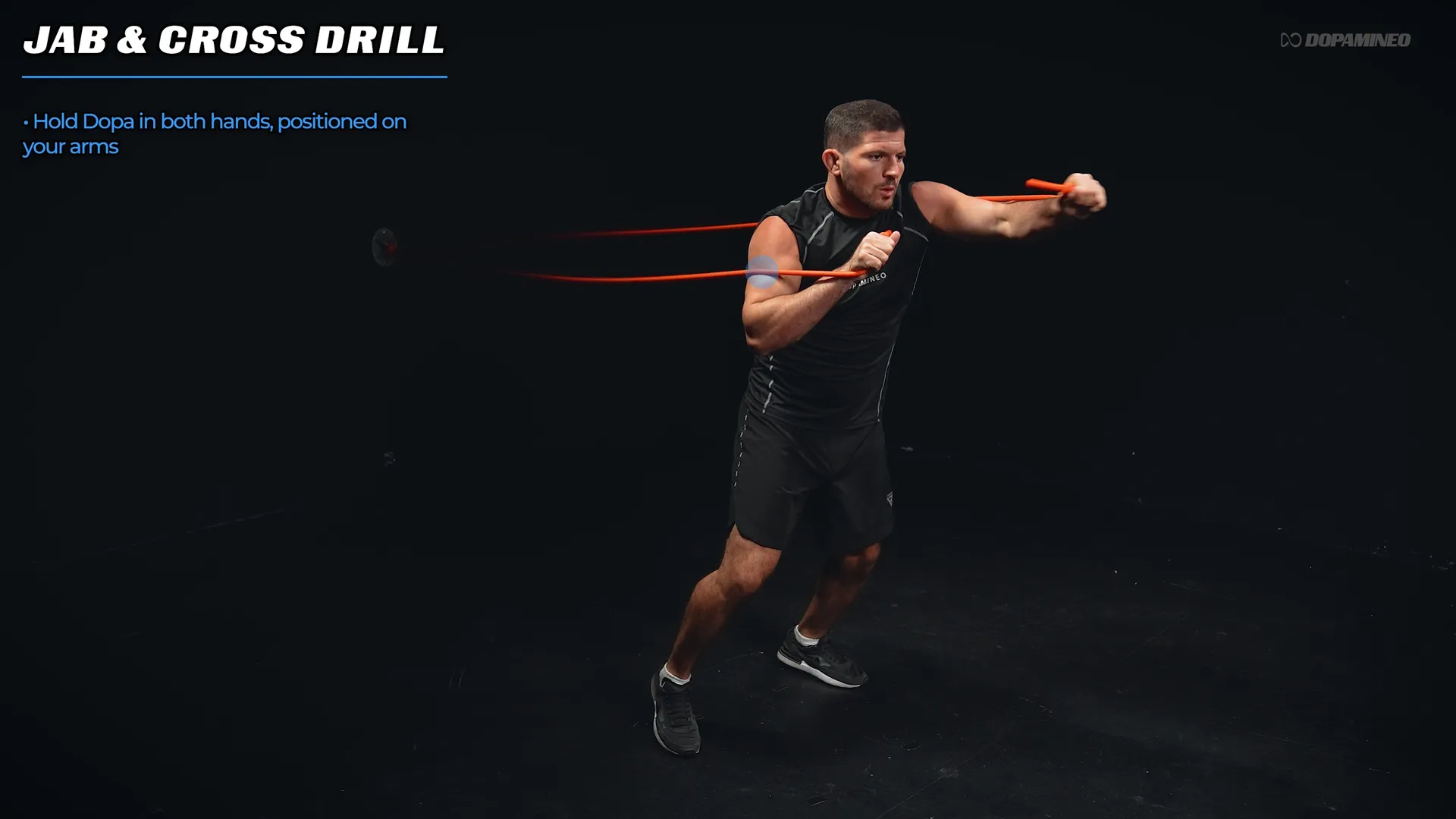
Most boxers anchor bands incorrectly, rendering their resistance training ineffective for actual punching mechanics. For straight punches (jabs and crosses), anchor the band behind you at chest height with handles in both hands. The band should provide moderate tension when your arms are fully extended—this ensures adequate resistance at full extension without compromising your ability to return to guard position. Stand in your boxing stance with feet shoulder-width apart, then execute precise jabs with explosive acceleration through full extension. Control the return rather than letting the band snap your arm back, as this eccentric loading builds strength where most fighters are weakest.
3-Minute Jab-Cross Resistance Protocol for Fight Simulation
Set up your band for moderate resistance and perform jab-cross combinations for three-minute rounds with one-minute rest intervals—exactly matching fight duration. Focus on maintaining realistic timing and rhythm rather than rushing through movements. The resistance should feel like an opponent providing opposition, requiring you to work through the full combination while staying defensively aware. Complete four to six rounds based on your current conditioning level, gradually increasing resistance as your technique improves. This protocol develops the muscular endurance needed to maintain power deep into championship rounds when opponents typically fade.
Why Your Hooks Fall Short Without Proper Band Resistance
Hooks require a different anchoring position than straight punches—position the band to your side rather than behind you. For lead hooks, anchor at waist height on your dominant side (opposite your lead foot) and grasp the handle with your lead hand. Execute the hook by rotating your hips and shoulders while keeping your elbow bent at ninety degrees, tracing a horizontal arc toward your target. The band provides resistance throughout the rotation, peaking when your fist reaches full extension directly in front of your chin. Most boxers make the mistake of anchoring too high or too low, which creates unnatural resistance vectors that don’t match actual hook mechanics.
Shoulder Injury Prevention Exercises Every Boxer Must Do

External Rotation: Fix Your Rotator Cuff in 10 Minutes Daily
This simple exercise prevents the shoulder impingement that sidelines countless fighters. Anchor the band at elbow height beside you, grasp the handle with your outside arm, and position your elbow against your side with your forearm parallel to the floor. Rotate your forearm away from your body to approximately forty-five degrees while keeping your elbow stationary. Perform three sets of twelve repetitions per arm daily, focusing on controlled movement rather than speed. For enhanced shoulder stability that better matches punching mechanics, create a small gap between your elbow and ribs—this position recruits additional stabilizer muscles critical for maintaining proper shoulder alignment during combinations.
Scapular Stability Drills That Prevent Boxing Shoulder Pain
Poor scapular control causes more shoulder injuries than any other factor in boxing. Anchor the band at chest height in front of you, grasp both handles, and sit back into your hips with a flat back. Pull the handles toward your lower chest while actively retracting your shoulder blades together. Squeeze your shoulder blades at the end of each repetition before slowly extending back to starting position. Perform three sets of fifteen repetitions before technical boxing sessions to activate the muscles that stabilize your shoulder joint during punching. This simple prehab exercise maintains proper shoulder mechanics even when you’re fatigued during late-round combinations.
Core Power: Rotational Exercises for Knockout Punches
Your core generates 60% of your punching power, yet most boxers neglect rotational strength training. Resistance bands develop this critical power while training your ability to resist unwanted rotation when absorbing punches.
Anti-Rotation Holds That Stop Opponents’ Power
Anchor the band at chest height to your side, grasp the handle with both hands, and step away to create tension. With hands at your chest and elbows tucked in, extend your arms straight out while bracing your core to resist the band’s rotational pull. Hold for thirty seconds before returning to starting position. Complete three sets per side to develop the stability that maintains your punching technique when absorbing body shots. The key is engaging your entire core—not just your abs—as if preparing to take a punch while maintaining perfect defensive positioning.
Lower Body Band Exercises for Boxing Footwork
Lateral Band Walks for Better Angles and Defense
Position a mini band around your ankles and assume an athletic stance with feet shoulder-width apart. Step laterally with one foot while maintaining tension on the band, then bring your trailing foot to meet it. Complete fifteen steps in one direction before reversing. For increased glute activation that better replicates boxing footwork, position the band around your thighs just above the knees. Perform these walks before sparring sessions to activate the hip stabilizers essential for creating angles, evading attacks, and maintaining optimal fighting distance during exchanges.
How to Structure Your Resistance Band Boxing Program
The 3-Day Weekly Schedule for Amateur Fighters
Day 1: Punch Power and Shoulders – Warm up with arm circles and light punches, then complete four rounds of band-resisted jab-cross combinations (3 minutes on, 1 minute rest). Follow with external rotations (3×12 per arm), internal rotations (3×12 per arm), and YTW exercises (3×10 per position).
Day 2: Lower Body and Core – Begin with band walks and bodyweight squats, then perform band-resisted squats (4×10), single-leg RDLs (3×8 per leg), and lateral band walks (3×15 steps each direction). Finish with wood chop variations (3×10 per side) and anti-rotation holds (3×30 seconds per side).
Day 3: Combination and Conditioning – After warm-up, complete 4-6 rounds of jab-cross-uppercut combinations against resistance (3 minutes on, 1 minute rest), focusing on technique maintenance under fatigue.
Common Band Training Mistakes That Sabotage Progress
The Grip Tension Error That Slows Your Punches
Most boxers grip band handles too tightly during punching drills, which recruits forearm muscles that should remain relaxed during actual punching. This unnecessary tension reduces punching speed, accelerates forearm fatigue, and creates muscle imbalances. Practice holding the handles with just enough grip to maintain control—imagine your fingers barely touching the handles while your larger arm muscles generate the movement. If you notice your forearms burning during band punching drills, you’re gripping too hard and undermining the exercise’s purpose.
Why Incomplete Range of Motion Ruins Your Technique
Shortening your punch extension to avoid challenging resistance creates muscle memory of restricted movement patterns that carry over to actual sparring. Perform band punching drills in front of a wall or mirror with a visible reference point for full extension. If you cannot maintain complete range of motion with proper technique, reduce the resistance level rather than sacrificing form. Remember: punching power develops through full extension, not partial movements that feel easier.
Equipment Safety: Avoiding Band Failures and Injuries
When to Replace Your Resistance Bands (Before They Snap)
Before each session, examine bands for small cracks, fraying edges, permanent deformation, or thinning areas. Latex bands typically last 3-6 months with regular use—replace them immediately if you notice any signs of wear, even if they haven’t completely failed. Store bands in a cool, dark location when not in use, as UV exposure and extreme temperatures accelerate degradation. Never anchor bands to unstable objects or hollow-core doors, which can fail during training and cause injury.
Learning how to use resistance bands for boxing properly transforms these simple tools into powerful training assets that build fight-winning attributes. The portability and affordability of bands make them accessible to every boxer, while their specific training effects deliver results that traditional weights often miss. By implementing these exact protocols consistently, you’ll develop the explosive punching power, durable shoulders, and late-round stamina that create championship performances. Remember: resistance bands don’t replace technical boxing work—they enhance it by building the physical foundation that allows your skills to shine when it matters most. Start with lighter resistance to master the movements, then progressively challenge yourself as your technique improves for maximum transfer to actual ring performance.